Quick Answer
A cherry grove is a mountain biome covered in pink-leaved cherry trees, found on lower mountain slopes and standalone plateaus. It's one of the smallest and prettiest biomes in the game, but it's also one of the least forgiving to live in long-term: no villages spawn here, and Java Edition blocks sugar cane and pumpkins from growing naturally. Use /locate biome minecraft:cherry_grove in Java Edition, or search mountain foothills near plains and sunflower plains if you're playing without cheats. Expect pigs, sheep, rabbits, bees, and the usual night-time Overworld monsters.
Key Facts
|
Attribute |
Detail |
|
Added in |
Java 1.20 (Trails & Tales), Bedrock 1.20.0 |
|
Biome type |
Mountain slope / plateau |
|
Java biome ID |
cherry_grove |
|
Bedrock numeric ID |
192 |
|
Temperature |
0.5 (Java) / 0.3 (Bedrock) |
|
Downfall |
0.8 (rain, not snow, on natural terrain) |
|
Rarity |
Uncommon, often generates as small "microbiomes" |
|
Signature block |
Pink petals |
|
Signature wood |
Cherry (pink leaves, light pink-brown planks) |
|
Villages |
Do not generate |
|
Pillager Outposts |
Can generate |
|
Pigs, sheep, rabbits |
|
|
Sugar cane/pumpkins |
Cannot generate naturally (Java) |
What Is the Cherry Grove Biome?
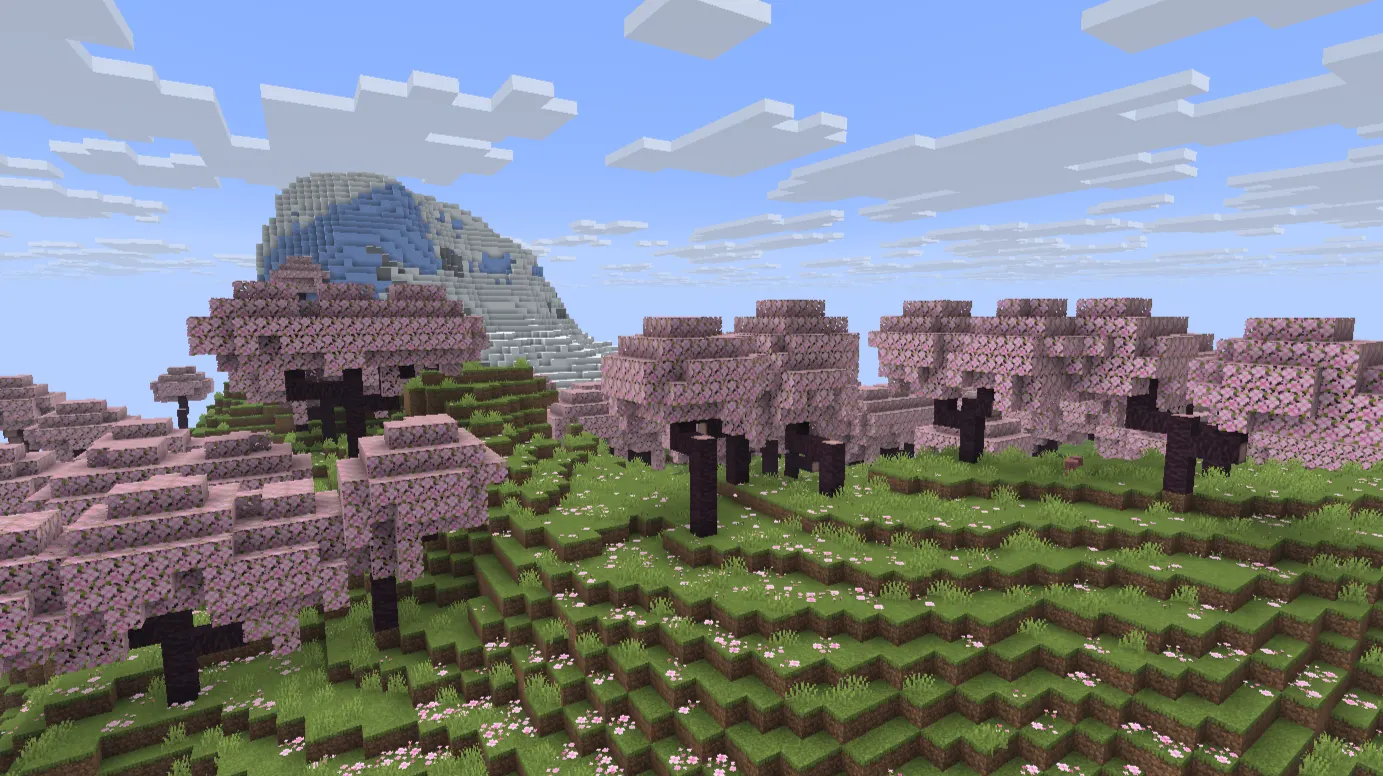
Cherry Grove was added in the Trails & Tales update, and it's still one of the few biomes that looks completely different from everything around it. Where meadows are all green and gold, cherry groves are pink from the canopy down to the petals scattered across the grass. The trees themselves are the whole point: curved trunks, multiple overlapping canopies, and a constant drift of petal particles falling through the air. Walk through one at sunset, and it's genuinely one of the better screenshots the game offers without any shaders.
Mechanically, though, a cherry grove is close to a reskinned meadow. Same shape rules, same general spawn behavior, same relationship to mountain terrain. The differences are specific: cherry trees instead of open grass, pink petals instead of wildflowers, pigs in the mob list where meadows have donkeys, and a strict no-village policy that meadows don't share. If you've built in a meadow before, a cherry grove will feel familiar within the first few minutes, and that similarity is worth remembering when you're deciding where to actually settle.
Where Cherry Grove Generates
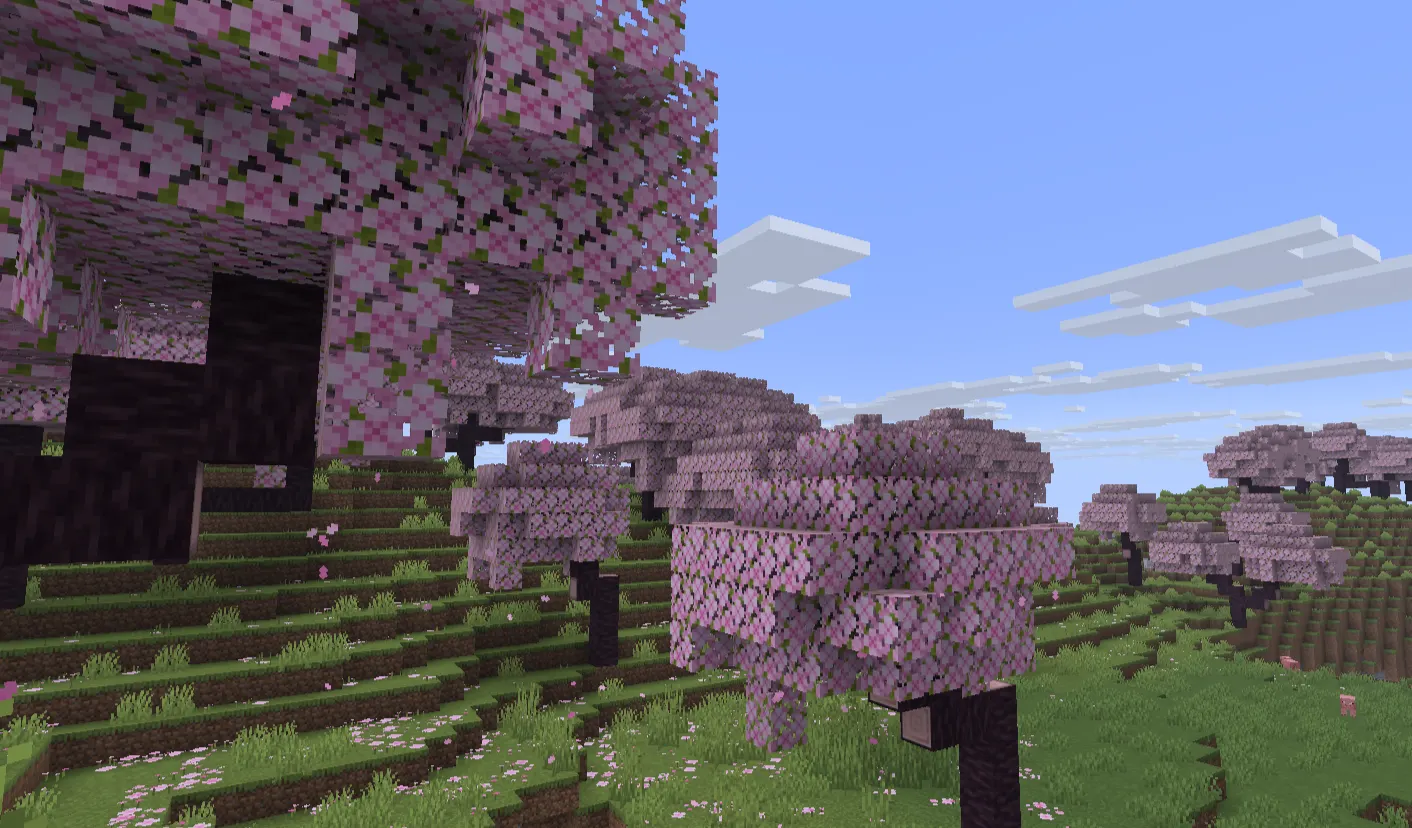
Cherry groves generate on mountain slopes, as standalone plateaus, or as valleys sitting inside a ring of mountains, always in medium temperature zones. That flexibility is why grove size varies so wildly between seeds. Sometimes you get a strip of pink trees a few blocks wide clinging to a hillside. Sometimes it's a plateau that runs for hundreds of blocks. Rarely, cherry groves generate as the entire mountain ring on their own, encircling whatever biome sits in the middle.
Biome borders follow a pattern:
-
On the valley side, cherry groves border sunflower plains or plains.
-
On the mountain side, they border frozen peaks and snowy slopes.
-
When temperature shifts slightly, they border meadows or savanna plateaus.
-
When humidity increases, they border forests and groves.
-
Rarely, in cold temperature zones, they can border ice spikes.
Mountains that host cherry groves are usually separated from meadow, jagged peaks, and flower forest mountains by rivers or dry valleys, which is part of why you'll sometimes cross a river and suddenly be in a completely different mountain biome.
Important note: Because cherry groves can be so small, don't assume you've found the whole biome the moment you spot pink leaves. Walk the perimeter before deciding it's not worth building on. A grove that looks tiny from one angle can wrap around a ridge and open up on the other side.
How to Find a Cherry Grove Fast
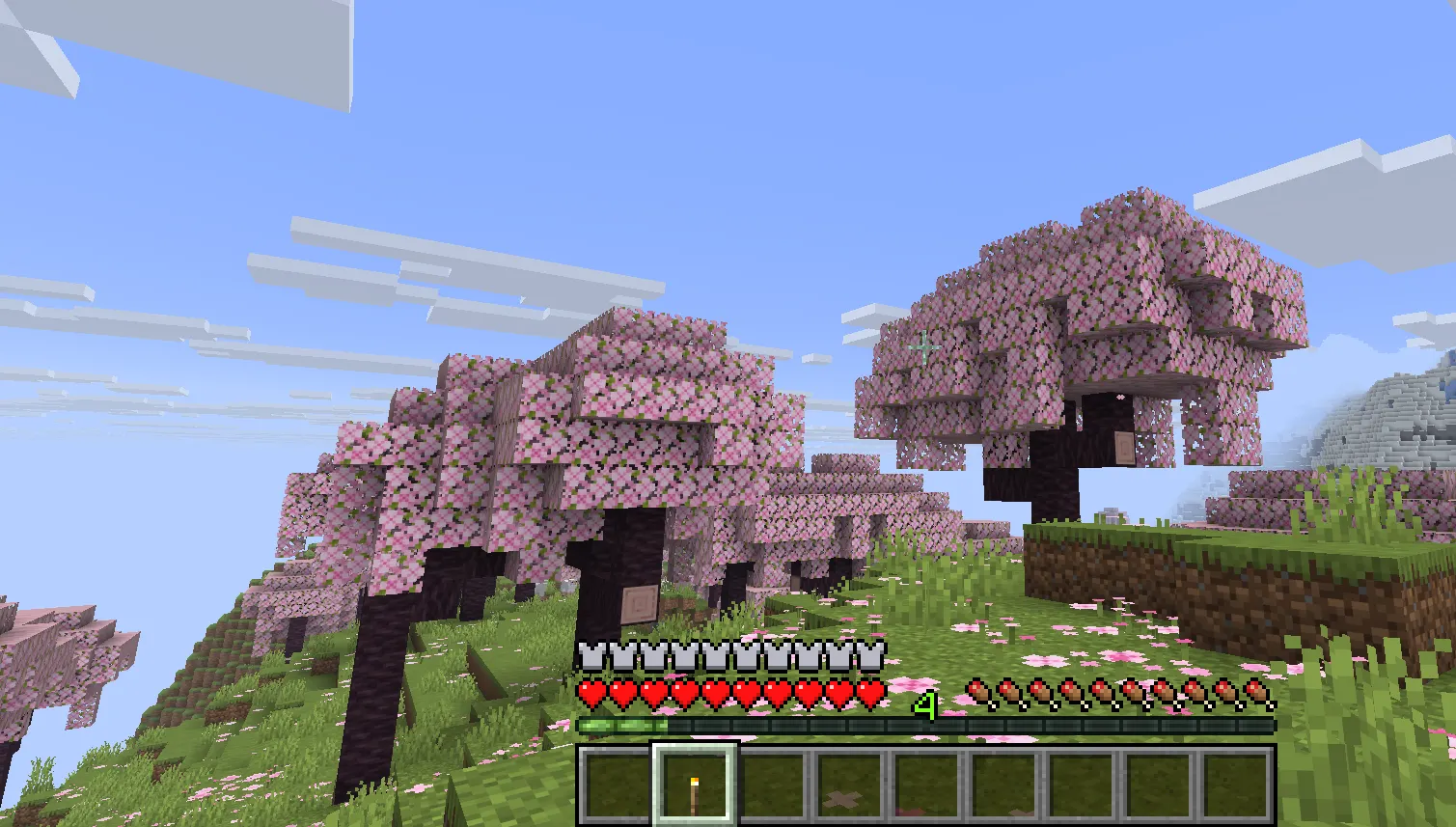
With cheats/commands (Java Edition):
/locate biome minecraft:cherry_grove
This returns the coordinates of the nearest cherry grove chunk. It's not always close, especially on smaller or heavily-explored maps, but it's the fastest way to confirm one exists nearby.
Without cheats:
-
Head toward any mountain biome group. Cherry groves generate alongside meadows, snowy slopes, and jagged peaks.
-
Watch the skyline. Pink canopies are visible from a long way off, especially against grey stone or snow.
-
Check lower slopes first. Cherry groves favor the base and mid-elevation of mountains rather than the peaks.
-
If you're near plains or sunflower plains that border hills, follow the treeline upward. That's a common transition point.
-
Boats and elytra make scanning mountain ranges much faster than walking, if you have access to either.
Seed-based methods: Several community seed databases catalog cherry grove spawns close to spawn point, which is useful if you specifically want one for a fresh world rather than searching an existing save. Search "Minecraft cherry grove seed" plus your edition and version for current listings, since seed results are version-dependent and older lists sometimes reference outdated chunk generation.
Terrain and Generation Mechanics
Cherry groves inherit the same terrain shaping as meadows: rolling elevation, occasional small cliffs, and grass that reads as a slightly more arid green than plains grass. The ground cover leans heavily on short grass and pink petals, with tall grass mixed in less frequently. Infested blocks (the ones that hide silverfish) can naturally generate here too, so don't be surprised if a stone-looking block bites back while you're digging a foundation.
Emerald ore shows up here the same way it does in meadows and windswept hills: more common at higher altitude. Coal and iron ore are both frequent finds if you tunnel down from the surface, which makes cherry grove a genuinely decent early-game mining base despite its reputation as a purely decorative biome.
One quirk worth knowing: in Bedrock Edition, cherry groves are coded as cold enough to allow snowfall above Y=200±8. In practice, this rarely happens on natural terrain, since the biome doesn't generate at those heights under normal world generation. It only matters if you're building extremely tall structures or using superflat/custom generation.
Trees and Vegetation
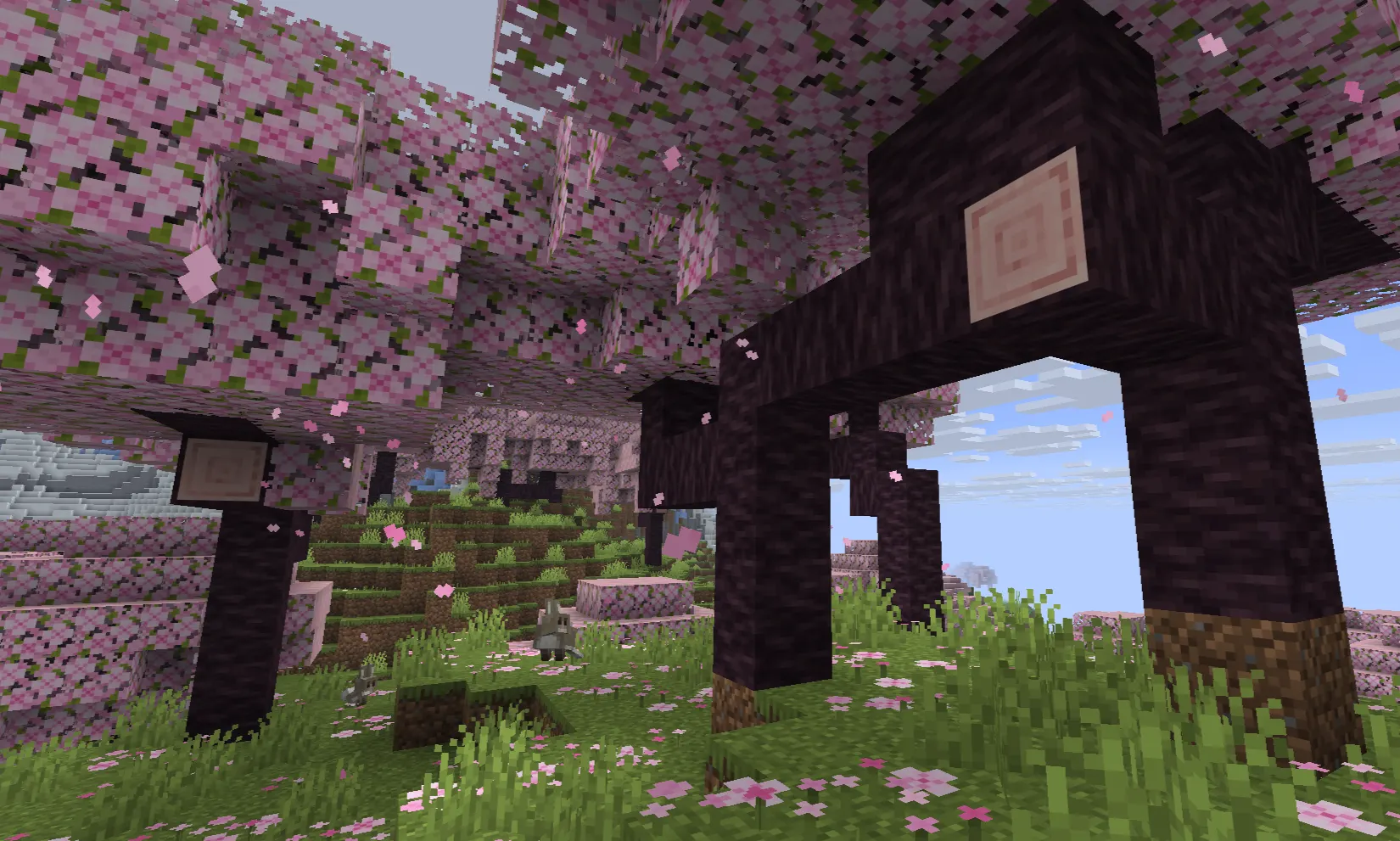
Cherry trees are the reason this biome exists, and they behave a bit differently from other Overworld trees. They're closer in structure to acacias, with multiple canopies branching off separate limbs rather than one solid crown, and they can grow dense enough that the ground below sits in near-permanent shade.
Growing your own:
-
A cherry sapling needs a 5×5 unobstructed area starting 8 blocks above it (9 blocks including the sapling's own space) to grow into a full tree.
-
No horizontal clearance is needed right at the base. You can plant a sapling in a 1-block-deep hole and it'll still grow.
-
Existing logs, leaves, and other saplings don't block growth, so tightly packed orchards are possible.
-
Saplings can be planted on dirt, grass blocks, coarse dirt, podzol, mycelium, rooted dirt, moss block, pale moss block, farmland, mud, and muddy mangrove roots, which is more surface options than most tree types get.
-
Fully grown, a cherry tree can reach up to 11 blocks tall with a canopy spreading as wide as 17×17 blocks, based on extensive community testing with repeated bone meal generation.
Because the canopy spread is so wide, cherry trees are a poor choice for a tightly packed automatic tree farm unless you're deliberately building around the branch pattern. They're much better suited to scattered, natural-looking groves.
Pink Petals Explained
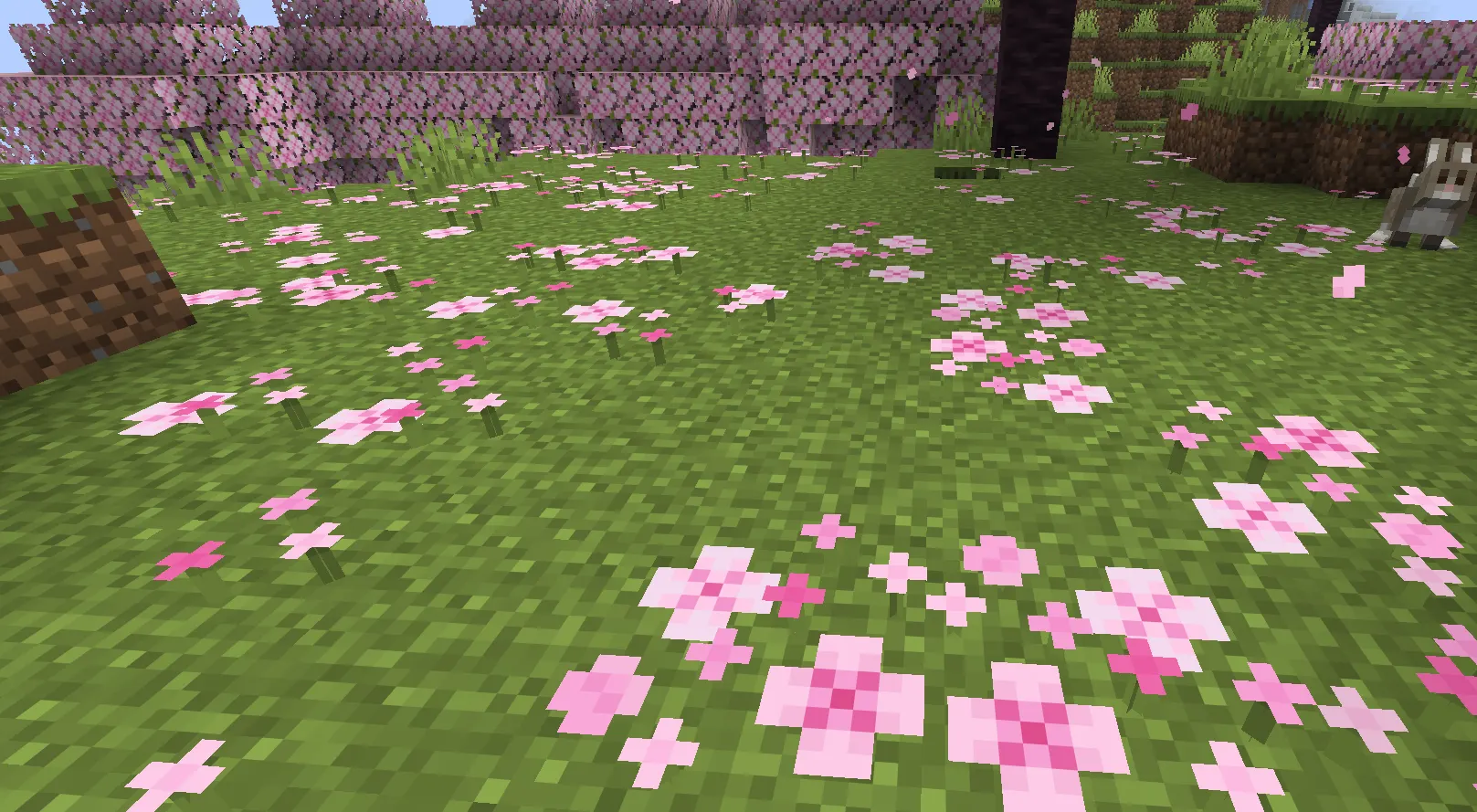
Pink petals are the ground-cover block unique to this biome, and they're one of the more overlooked decorative blocks in the game. Bone meal used on grass blocks inside a cherry grove generates pink petals instead of the small flowers you'd get in most other biomes, so if you're trying to farm dyes or decorative flowers here, bone meal won't give you what you're used to.
Pink petals can be picked up and placed anywhere, which makes them a genuinely good decorative item outside their native biome. They stack in groups on a single block space (similar to how flower pots or candles handle multiple items), so a single block area can visually hold several petal clusters. Use them along garden paths, inside planter boxes, scattered near ponds, or layered under cherry saplings you've transplanted elsewhere to sell the "cherry blossom" look without needing the whole biome.
Resources You Can Find
|
Resource |
How to Get It |
Notes |
|
Cherry logs |
Chop cherry trees |
Any tool works, including bare hands |
|
Cherry leaves |
Shear the canopy |
Regular breaking destroys them without drops |
|
Cherry saplings |
Break leaves (random chance) |
Needed to grow new trees |
|
Sticks |
Break leaves (random chance) |
Same drop table as saplings |
|
Pink petals |
Bone meal on grass, or break existing petals |
Decorative only |
|
Bee nests |
Occasionally attached to trees near flowers |
5% chance per qualifying tree |
|
Coal ore |
Underground mining |
Common |
|
Iron ore |
Underground mining |
Common |
|
Emerald ore |
Underground mining, higher altitude |
Same rarity pattern as meadows |
|
Infested stone |
Underground, natural generation |
Releases silverfish when broken |
Sugar cane and pumpkin patches are explicitly excluded from natural generation in cherry groves on Java Edition, which is unusual. Almost every other Overworld biome that touches water or grass can spawn one or both. If you want either, you'll need to plant them yourself.
Animals and Passive Mobs
The passive mob list here is short and specific: pigs, sheep, and rabbits. That's it, no cows, no chickens, no donkeys. If you're setting up a mob farm or just want steady food, you'll need to either breed what spawns naturally or bring in animals from elsewhere.
|
Mob |
Java spawn weight |
Bedrock spawn weight |
|
Sheep |
2/5 |
2 |
|
Rabbit |
2/5 |
2 |
|
Pig |
1/5 |
10 |
Pigs are notably more common on Bedrock relative to the other passive mobs than they are on Java, which is a small but real gameplay difference if you're farming pork chops specifically.
Glow squids can also spawn here as an underground water creature (in bodies of water within the biome), and bats spawn as ambient mobs in dark areas, same as most other Overworld biomes.
Hostile Mobs
Standard Overworld night-time spawns apply, with one addition worth flagging.
|
Mob |
Java spawn weight |
Bedrock spawn weight |
|
100/515 |
100 |
|
|
100/515 |
80 |
|
|
100/515 |
100 |
|
|
95/515 |
95 |
|
|
Slime |
100/515 (slime chunks only) |
100 (slime chunks only) |
|
10/515 |
10 |
|
|
Witch |
5/515 |
5 |
|
Zombie Villager |
5/515 |
5 |
Slimes spawning here depends entirely on whether the chunk is a designated slime chunk, exactly like most other non-swamp biomes. There's nothing cherry-grove-specific boosting or suppressing them.
Warning: Because cherry groves often sit right against open plains or sunflower plains, a base built at the biome edge can end up catching Mob spawns from both sides at once. Fence and light accordingly, especially if your build straddles the border.
Bee Nests and Beekeeping
Cherry trees can generate with a bee nest attached, the same way oaks and birches sometimes do. A cherry tree grown from a sapling within 2 blocks of a flower has a 5% chance of spawning with a nest containing 2–3 bees. Naturally generated groves also get nests "somewhat commonly" on the sides of trees, according to observed world generation, so a large cherry grove will usually have a handful scattered through it even before you plant anything.
For beekeeping specifically:
-
Harvest nests with silk touch to relocate them without angering the bees.
-
Plant flowers near any cherry sapling you want to have nest odds, since the 5% chance only applies within that 2-block flower radius.
-
Cherry leaves themselves don't count as flowers for pollination purposes, so you still need actual flowering plants nearby.
-
Petals on the ground do not attract bees or count as pollen sources.
If honey and dye production matter more to you than the cherry aesthetic, a plains or flower forest biome will actually give you more consistent bee density. Cherry grove's charm here is more about scenery than yield.
Nearby Structures
-
Pillager Outposts generate in cherry groves, same as most Overworld biomes. Clear one early if you're settling nearby, since the pillager patrols they spawn will otherwise harass your base indefinitely.
-
Villages do not generate in cherry groves under any circumstances. If you want easy trading access, you'll need to walk into an adjacent plains or sunflower plains biome, or build your own trading hall from scratch.
-
Ruined portals, mineshafts, and caves can appear underground the same as in any other Overworld biome, since those are driven by underground generation rules rather than surface biome type.
-
Abandoned camps are a newer structure that can generate in cherry groves as part of an upcoming content drop; check current patch notes for your platform before planning a build around one, since rollout timing differs between Java and Bedrock.
Farming in a Cherry Grove
Standard crop farming works fine here. The biome supports farmland and crop growth like any temperate Overworld area. The catch is entirely about what generates naturally versus what you plant:
-
You must manually plant sugar cane and pumpkins; neither spawns on its own.
-
Wheat, carrots, potatoes, and beetroot grow normally once you've got farmland and water nearby.
-
Bamboo does not generate naturally here either, so if you need it for scaffolding or fuel, bring some in.
-
Animal farming is limited to what spawns (pigs, sheep, and rabbits) unless you transport other animals in.
If you're planning a fully self-sufficient base, cherry grove works better as one piece of a wider setup than as your only farmland. Bring seeds, bring a cow or two, and treat the biome's natural resources as a bonus rather than your entire food plan.
Cherry Wood: Crafting and Uses
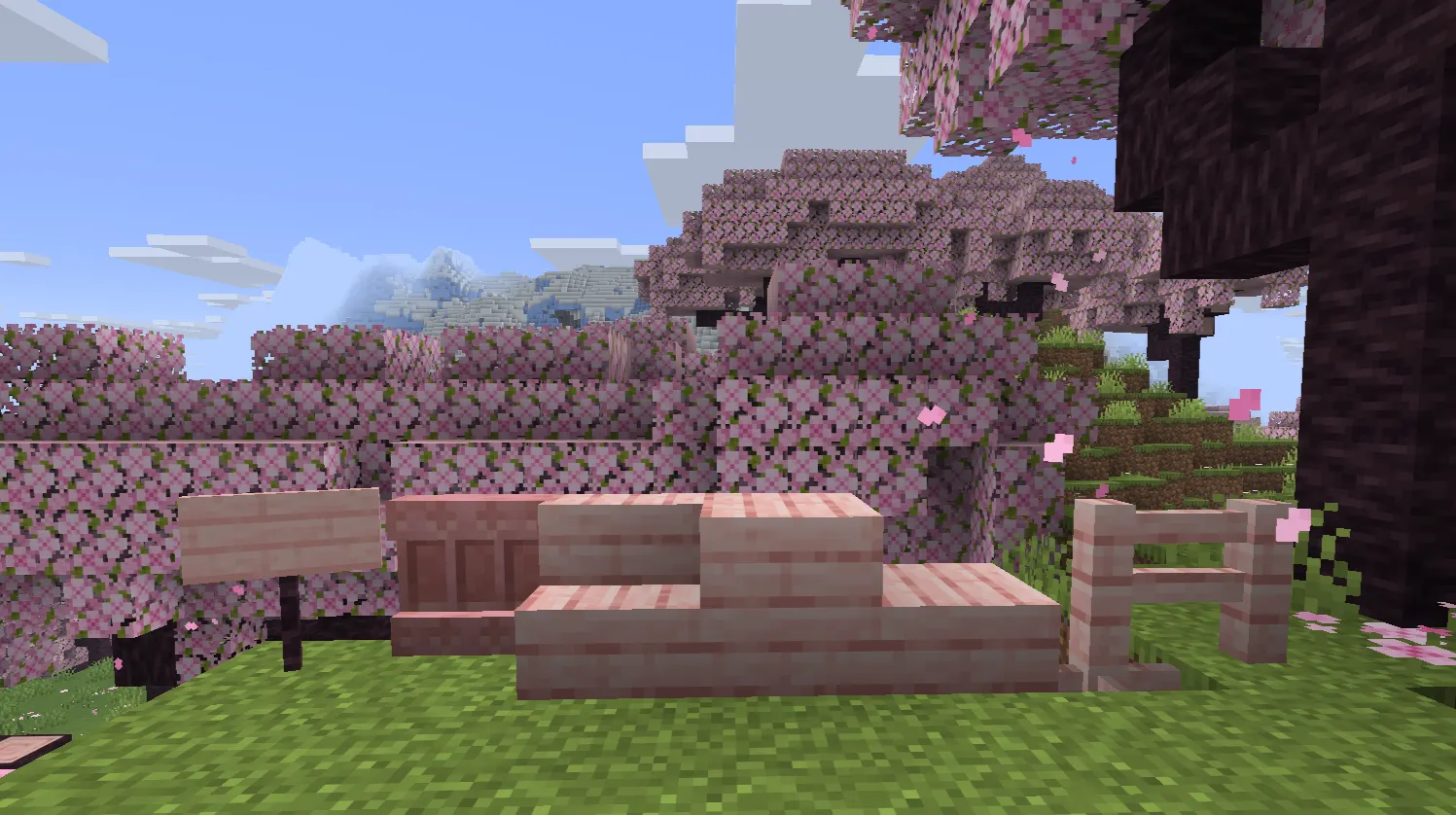
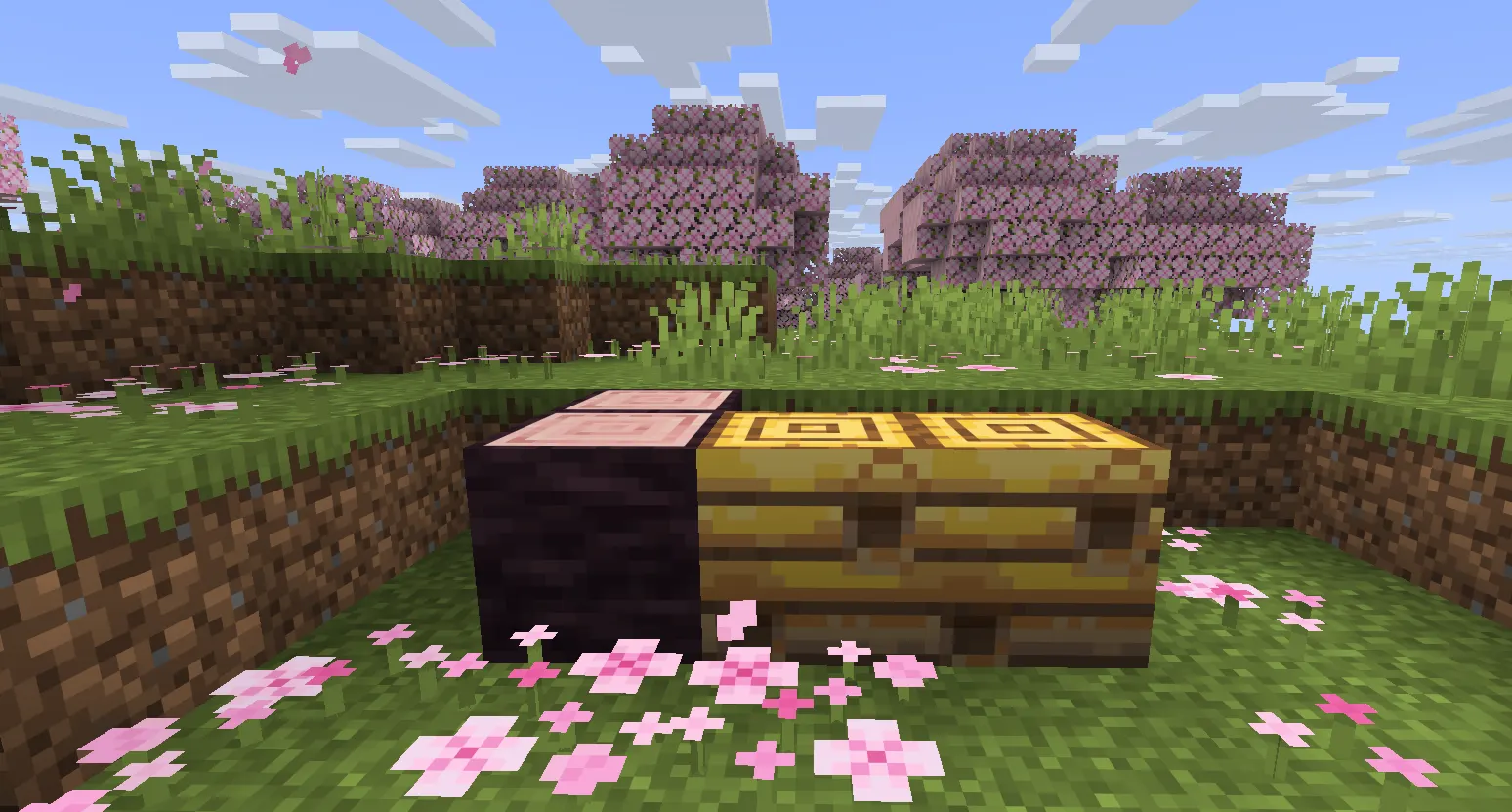
Cherry wood has its own distinct plank color: a warm, light pink-brown that reads as "spring" without looking neon. It functions identically to every other wood type in terms of Crafting, covering full stairs, slabs, doors, trapdoors, fences, fence gates, pressure plates, buttons, signs, hanging signs, boats, and the standard Wooden tool and weapon set.
|
Item |
How to Craft |
|
Cherry Planks |
1 Cherry Log → 4 Planks |
|
Stripped Cherry Log |
Use an axe on a Cherry Log |
|
Cherry Stairs / Slabs / Fences |
Standard wood recipes using Cherry Planks |
|
Cherry Door / Trapdoor |
Standard wood recipes |
|
Cherry Boat |
5 Cherry Planks in a boat shape |
|
Wooden Tools / Weapons |
Standard recipes using Cherry Planks |
Cherry is one of the few wood types (alongside bamboo) that isn't part of a matched "log family" visually with any other type. Its plank tone doesn't blend the way oak and dark oak do, or spruce and stripped spruce. That's actually useful for builders: it reads as its own distinct material, which makes it a strong accent wood rather than a whole-structure wood in a lot of designs.
Practical pairing ideas:
-
Cherry Wood + White Concrete or Quartz for a clean, bright spring look
-
Cherry Wood + Dark Oak or Spruce for high-contrast trim and framing
-
Cherry Wood + Stone Bricks for a cottage-core aesthetic
-
Cherry Planks as flooring under a mostly-stone or mostly-white build to add warmth without dominating the palette
Best Base and Building Ideas
Cottage in the grove. Small footprint, cherry wood frame, stone foundation, petal garden out front. This is the build Cherry Grove is designed for, and it photographs well with minimal effort.
Treehouse-adjacent platform. Because cherry canopies spread so widely, you can build a raised platform partially under the leaf cover to get natural shade and protection from rain without cutting the tree down.
Zen garden/meditation space. Combine petals, water, stone paths, and a few strategically kept trees for a low-structure decorative area. This works especially well as an add-on to a larger base elsewhere, using the grove purely for atmosphere.
Mountainside overlook. If your grove sits on a slope, build outward on stilts or a partial cliff-face structure to get a view over the valley below. Cherry groves often border plains or sunflower plains, so the view down is usually worth the extra building effort.
Petal courtyard. A fully enclosed courtyard using collected petals as the entire floor, framed by cherry wood fencing. Cheap to build, high visual payoff, and a nice contrast area next to a stone or concrete main structure.
Advantages and Disadvantages
|
Advantages |
Disadvantages |
|
Extremely distinctive, high-value screenshots and builds |
No villages, so no easy trading access |
|
Gentle terrain, easy to build on |
Small biome footprint on many seeds |
|
Good mix of coal, iron, and emerald |
No sugar cane or pumpkins without manual planting |
|
Unique cherry wood palette for builders |
Limited passive mob variety (no cows or chickens) |
|
Bee nests support honey and dye production |
Bamboo doesn't generate naturally |
|
Rain instead of harsh snow (unlike some mountain biomes) |
Pillager outposts can generate nearby, adding pressure |
Cherry Grove vs Other Biomes
Cherry Grove vs Meadow
|
Feature |
Cherry Grove |
Meadow |
|
Trees |
Dense cherry trees |
Sparse, occasional oak/birch |
|
Villages |
No |
Yes (mountain variant) |
|
Passive mobs |
Pigs, sheep, rabbits |
Sheep, rabbits, occasional donkeys |
|
Ground cover |
Pink petals |
Wildflowers |
|
Temperature (Java) |
0.5 |
0.5 |
|
Rarity |
Rarer |
More common |
They're structurally near-identical biomes, which is why the wiki itself calls cherry grove "very similar to meadows." The village access alone makes meadow the better long-term settlement choice if that matters to you.
Cherry Grove vs Plains
Plains sit at low elevation, generate villages constantly, and support both sugar cane and pumpkins naturally. Cherry grove trades all of that away for scenery and a mountain setting. If you want a practical starting biome, plains still wins on pure utility; cherry grove wins if you're optimizing for how the base looks.
Cherry Grove vs Forest
Forest biomes are flatter, denser with oak and birch, and generate at low-to-mid elevation without the mountain terrain. Forest gives you more consistent lumber volume per chunk; cherry grove gives you a distinct wood type and a much better view.
Cherry Grove vs Flower Forest
Flower forest actually beats cherry grove on flower variety and bee density, since it generates a wide mix of every flower type plus regular trees with nest odds. Cherry grove wins purely on the petal aesthetic and the cherry wood palette, which flower forest doesn't offer at all.
Java vs Bedrock Differences
|
Difference |
Java Edition |
Bedrock Edition |
|
Temperature value |
0.5 |
0.3 |
|
Sugar cane / pumpkins |
Explicitly cannot generate |
Not restricted the same way |
|
Pig spawn weight |
1/5 (lower relative rate) |
10 (higher relative rate) |
|
Skeleton spawn weight |
100/515 |
80 |
|
Cold/snowfall coding |
Not applicable |
Coded cold above Y=200±8 (rarely relevant) |
|
Locate command |
/locate biome minecraft:cherry_grove |
/locate biome cherry_grove (Bedrock syntax) |
Most of these differences won't change how the biome feels to play in day-to-day, but the sugar cane/pumpkin restriction is worth knowing before you plan a farm layout, since it's easy to assume both editions behave the same way here.
Multiplayer Tips
-
Claim early, build fast. Because cherry groves are small on a lot of seeds, multiple players wanting to build "in the pink trees" can run out of usable space quickly. Establish plot boundaries before anyone starts terraforming.
-
Share the petal supply. Bone-mealing every grass block in sight for petals can strip a small grove bare visually. Coordinate if the server has a shared cherry grove spot people want to keep looking natural.
-
Centralize trading elsewhere. Since villages don't spawn here, set up a shared trading outpost in the nearest plains or sunflower plains rather than each player making separate trips.
-
Watch for outpost patrols if a Pillager Outpost generated nearby. These can wander into a shared build zone and cause chaos during a build session if nobody's cleared it.
Common Mistakes
-
Assuming villages will spawn nearby. They won't, ever, inside the biome itself.
-
Planting sugar cane by rivers expecting natural regrowth patches elsewhere in the biome. It only exists where you plant it.
-
Bone-mealing grass for flowers and getting confused by petals instead. This is intended biome behavior, not a bug.
-
Underestimating how wide a mature cherry tree canopy gets and planting saplings too close together.
-
Building right on the plains/sunflower plains border without extra lighting, then getting surprised by mob spawns crossing biome lines at night.
-
Ignoring the small size of many cherry grove instances and committing to a large build plan before scouting the full biome footprint.
-
Forgetting bamboo doesn't spawn here and having no early scaffolding material on hand.
Hidden Mechanics and Interesting Facts
-
Cherry trees are structurally modeled closer to acacia trees than oak, which is why the branching looks so irregular compared to a standard round canopy.
-
During development, the cherry leaves texture was originally placeholder pig textures, an internal joke that Mojang later confirmed publicly.
-
The maximum recorded cherry tree size from extensive community testing is 11 blocks tall with a 17×17 canopy spread, though most naturally generated trees are considerably smaller.
-
Cherry grove can rarely generate in cold temperature zones and border ice spikes, which produces one of the more visually jarring biome transitions in the game: pink blossoms next to towering ice spires.
-
The "Adventuring Time" advancement, which requires visiting every Overworld biome, includes cherry grove as one of its required stops.
-
Cherry grove's music pool overlaps heavily with other calm biomes (tracks like "Home" and "Memories"), which is part of why exploring it feels deliberately peaceful compared to combat-heavy biomes.
Pro Tips
Beginner tips:
-
Bring bone meal to speed up sapling growth if you find a small grove and want a denser canopy.
-
Shear leaves instead of breaking them if you want guaranteed leaf blocks for decoration.
-
Stock up on cherry saplings early. You'll want extras for transplanting elsewhere.
Advanced tips:
-
Use silk touch on bee nests before any construction work near trees, to avoid accidentally destroying an active nest.
-
Combine cherry planks with a light-colored base material (quartz, white concrete, birch) for builds that photograph well in both daylight and sunset lighting.
-
If you want a self-sufficient cherry grove base, plan a small adjacent farm plot from day one rather than retrofitting one later, since sugar cane and pumpkins need to be planted regardless.
Exploration checklist:
-
Confirm biome size before committing to a build location
-
Check for a nearby Pillager Outpost and clear it if present
-
Locate the nearest plains or sunflower plains for trading access
-
Identify water sources for farming
-
Note underground ore access points before finalizing a base layout
Survival checklist:
-
Torches or lanterns along biome borders to prevent cross-biome hostile spawns
-
Manual sugar cane and pumpkin planting if needed
-
Backup Food source beyond pigs, sheep, and rabbits
-
Bamboo or alternative scaffolding material brought in
Conclusion
Cherry grove rewards players who treat it as a specialty biome rather than a default home base. Its terrain is gentle enough to build on immediately, its wood and petals give you a decorative palette nothing else in the game matches, and the underground ore access is genuinely solid for early survival. What it won't do is hand you a village, a reliable food chain, or guaranteed sugar cane. Those gaps are real, and pretending they aren't leads to a lot of players getting frustrated a few days into a cherry grove playthrough.
The move that works best in practice: use cherry grove as your aesthetic anchor (the cottage, the overlook, the petal courtyard) while keeping your actual logistics, trading, farming, animal breeding, tied to an adjacent plains or forest biome you can walk to in a few minutes. That way you get the biome's best feature, the way it looks, without fighting its limitations the entire game.