
Phantom Guide in Minecraft: Why You Must Sleep & How to Kill Them
You've been mining for what feels like an hour. You climb back to the surface, and something screeches out of the dark sky and takes a chunk out of your health bar before you even see it coming. That's a phantom. It's Minecraft's way of telling you that you should have slept three nights ago.
Phantoms are the only Hostile mob that spawns because of something you didn't do rather than something in the environment. No torch placement fixes it. No amount of building can save you once the timer runs out, unless you actually address the cause. This guide covers what phantoms are, exactly why they show up, how to shut them down for good, and how to fight them if you'd rather farm the membranes than avoid them.
What Is a Phantom?

A phantom is a flying undead mob that spawns above players who haven't slept in three or more in-game days. It looks like a cross between a bat and a dragon, greenish-gray, skeletal, with tattered wings and glowing eyes, and it attacks by diving at your head from above.
Phantoms were added in the Aquatic Update (Java 1.13, Bedrock 1.6). Before that, staying awake indefinitely had zero downside besides your own patience. Mojang's early name for the mob during development was "Monster of the Night Skies," which is honestly a better description than "phantom."
They're undead, so they burn in daylight, take extra damage from Smite, get hurt by Instant Health potions, and are immune to Poison. They're also the fastest non-boss mob in the game, capable of hitting roughly 20 blocks per second when diving.
Why Do Phantoms Spawn?

Phantoms spawn because of the game's insomnia mechanic: once you've gone three full in-game days (72,000 ticks, which is one real hour of unpaused play) without sleeping in a bed or dying, you become eligible to spawn them.
That eligibility isn't automatic. Every time the game checks for a phantom spawn, several things need to line up:
-
It has to be night, or a thunderstorm has to be happening.
-
You need to be at or above sea level (Y=64).
-
There can't be a solid block directly over your head blocking the sky. Glass doesn't count as blocking, but leaves do, since leaves have a light opacity value above zero.
-
The local difficulty at your location has to beat a randomly rolled number between 0.0 and 3.0.
If all of that lines up, the game rolls a chance based on how many ticks have passed since you last slept. The formula works out to roughly a 25% chance on day 4, 40% on day 5, 50% on day 6, and about 57% on day 7, climbing higher the longer you stay awake. This is why the first phantom encounter often feels like bad luck and the fifth sleepless night feels like a siege.
Sleeping resets the "time since last rest" counter back to zero, which is the entire point of the mechanic. It's not that beds are magically phantom-repellent. It's that sleeping is the only action that resets the clock.
One thing worth clarifying for multiplayer: each player has their own personal sleep timer. If your friend sleeps every night and you don't, phantoms will still spawn for you specifically, even while your friend sleeps peacefully in the same base.
Why Minecraft Punishes Players for Not Sleeping
This mechanic exists because, without it, sleeping had no real function beyond skipping the night. Beds were basically decorative once you had a lit, Mob-proof Base. Phantoms gave sleep an actual mechanical purpose and gave long expeditions, mining trips, and building marathons a built-in cost.
It also fits the game's broader design philosophy: almost everything in Minecraft rewards routine and punishes neglect, from hunger to tool durability to crop growth. Insomnia is the sky version of that same idea. Ignore it long enough, and the game reminds you it's still tracking your choices.
Phantom Spawn Rules
|
Requirement |
Value |
|
Days without sleep |
3 in-game days (72,000 ticks / 1 real hour) minimum |
|
Time of night |
Night or during a thunderstorm (can trigger in daylight during storms) |
|
Sky access |
No solid block overhead; leaves block spawning, glass does not |
|
Elevation |
Y=64 or higher (at or above sea level) |
|
Difficulty scaling |
Local difficulty must exceed a random value between 0.0 and 3.0 |
|
Spawn location |
20–34 blocks above the player, within a roughly 21×15×21 area |
|
Phantoms per spawn (Easy) |
1–2 |
|
Phantoms per spawn (Normal) |
1–3 |
|
Phantoms per spawn (Hard) |
1–4 |
|
Java damage per hit |
2 HP (Easy/Normal), 3 HP (Hard) |
|
Bedrock damage per hit |
4 HP (Easy), 6 HP (Normal), 9 HP (Hard) |
Peaceful difficulty overrides all of this. Phantoms simply don't spawn there, and any existing phantoms despawn the moment you switch to it.
Phantom Behavior
Phantoms spend most of their time circling 15 to 25 blocks above and around your position in slow, lazy loops. That's their idle state, and it can lull you into forgetting they're up there.
Every 8 to 12 seconds on Java (10 to 20 seconds on Bedrock), a phantom breaks from its circle and dives straight at you. If it connects, it deals its damage and immediately banks back up to altitude. If you hit it while it's mid-dive, it aborts the attack and retreats without landing the hit, which is the entire basis for good phantom combat.
They track and target players from up to 64 blocks away; they don't drown, and they move through water at the same speed as through air. Like other undead mobs, direct sunlight sets them on fire, though they'll happily keep diving at you until the flames actually kill them.
How to Stop Phantom Spawning

There's more than one way to shut phantoms down, and some methods people swear by don't actually do what they think.
Sleep in a bed. This is the only method that resets your insomnia timer to zero. Everything else on this list either prevents spawning conditions or avoids phantoms without touching the underlying clock.
Cover your head with a solid block. Since phantoms need open sky to spawn near you, roofing your base, tunnel entrance, or AFK spot with anything that has light opacity stops spawns in that specific location. Glass won't work; stone, dirt, wood, even leaves will.
Stay below Y=64. Phantoms can't spawn near a player below sea level. This is why basement bases and cave dwellings are naturally phantom-proof, no roof required.
Switch to Peaceful difficulty. Hostile mobs, phantoms included, don't spawn at all on Peaceful.
Use commands. /gamerule doInsomnia false disables phantom spawning entirely, on any difficulty, without touching anything else in the world.
Keep a tamed cat nearby. Phantoms actively avoid getting within 16 blocks of any cat, tamed or not, and tamed cats hiss at phantoms that are attacking you, which pushes them off. This doesn't stop phantoms from spawning; it just keeps them from closing in. If you leave the cat's range, they'll come right back for you.
Now the myths. Camping under leaf blocks does work, since leaves block sky access, but people sometimes assume any overhead cover works, and glass ceilings are a common exception players get burned by. Cats are also frequently misunderstood as a spawn-prevention method; they're a deterrent once phantoms already exist, not a way to stop the timer from running.
How to Kill Phantoms Easily
The core trick to fighting phantoms well is timing, not gear. Since a phantom retreats the instant it takes damage during a swoop, you want to hit it right as it's diving at you, not chase it while it circles.
Sword. The standard choice. A diamond or netherite sword with Smite (since phantoms are undead) kills one in two to three hits depending on enchantment level. Time your swing for the moment it's within range during its dive.
Axe. More serious per-hit damage than a sword, useful if you're confident in your timing, since axes swing slower and punish missed hits harder.
Bow or crossbow. Effective if phantoms are still circling out of melee range, especially useful for picking off the first one before the group closes in. Power enchantments help drop them in one or two shots.
Trident. Works fine in melee and doubles as a ranged option when thrown, particularly handy if you're fighting phantoms while standing in or near water.
Shield. Blocking absorbs the knockback and most of the damage from a dive, but it won't stop the phantom from following up with another pass seconds later. Use it to buy time to reposition, not as your main defense.
The biggest mistake players make is standing still and swinging wildly at empty air while a phantom circles above. Watch its shadow and body language. When it tucks its wings and drops, that's your window. Step slightly to the side and swing as it passes, which both lands the hit and avoids taking the full knockback.
Best Enchantments
-
Smite turns phantoms into two- or three-hit kills on a diamond sword, since it's specifically bonus damage against undead mobs.
-
Looting increases your phantom membrane drops, up to 4 per kill at Looting III, which matters a lot if you're farming membranes for elytra repairs.
-
Power (bow) or Multishot/Piercing (crossbow) help thin out a group before they're all diving at once.
-
Knockback on a sword can actually work against you here, since it pushes the phantom out of easy follow-up range. Skip it for phantom fights specifically.
What Do Phantoms Drop?
Phantoms drop 0–1 phantom membrane per kill when killed by a player or a tamed wolf. That's not guaranteed, which is why Looting matters if you want a steady supply.
-
Looting I: up to 2 membranes
-
Looting II: up to 3 membranes
-
Looting III: up to 4 membranes
They also drop a small amount of experience when killed, same as most hostile mobs.
Phantom Membrane Uses
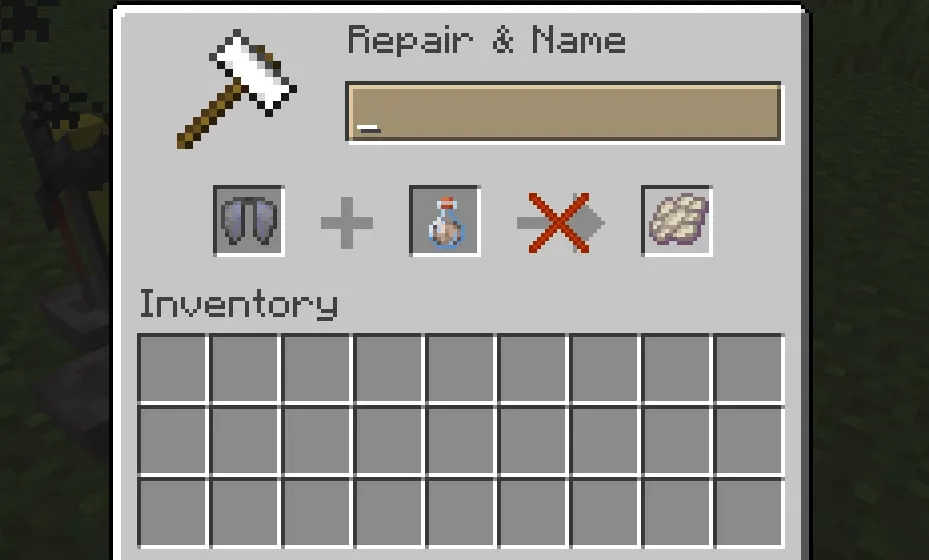
Phantom membrane has exactly two uses, and both matter a lot once you're deep into the mid-to-late game:
-
Repairing elytra. Placing a phantom membrane on an elytra at an anvil restores 108 durability points, which is 25% of the elytra's total durability, while keeping any enchantments intact. This matters because it's one of the only ways to repair elytra outside of Mending, and it doesn't require XP levels the way an anvil combine repair does.
-
Brewing Potions of Slow Falling. Add a phantom membrane to an Awkward Potion at a brewing stand to get a Potion of Slow Falling, which prevents fall damage and slows your descent for 90 seconds (extendable to 4 minutes with redstone). This is genuinely useful for exploring the End, navigating tall cliffs, or landing safely after a bad glide.
Given both uses, it's worth collecting membranes any time you're already fighting phantoms rather than treating the encounter as pure annoyance. If you use elytra regularly, keep a small stockpile on hand instead of scrambling for it later.
Can You Farm Phantoms?
Yes, and it's a legitimate late-game project, though it takes setup.
The basic idea: stay awake deliberately (usually by right-clicking a bed repeatedly without actually sleeping in it, which keeps you "trying" without resetting the timer), stand in an open-sky spot above Y=64, and let phantoms spawn on you in a controlled arena. Some players build these AFK platforms high in the sky specifically for this.
Pros: Consistent phantom membrane income, useful for elytra-heavy players who go through membranes fast, and a decent way to farm XP alongside membranes.
Cons: It's not fully automatable the way an Iron farm or a mob grinder is, since phantoms only spawn based on your personal insomnia state rather than by chance like other hostile mobs. You also have to actively fight or trigger a fall-damage kill system, which means more hands-on time than a passive farm. Efficiency is capped by how many phantoms can spawn per attempt (1–4 depending on difficulty) and how long you're willing to stay sleep-deprived.
It's a solid supplementary farm, not a background project you check once a week.
Java vs Bedrock Differences
|
Category |
Java Edition |
Bedrock Edition |
|
Damage per hit |
2 HP (Easy/Normal), 3 HP (Hard) |
4 HP (Easy), 6 HP (Normal), 9 HP (Hard) |
|
Swoop attack frequency |
Every 8–12 seconds |
Every 10–20 seconds |
|
Underwater behavior |
Doesn't drown, moves normally |
Tries to surface, can drown after 20 seconds if trapped |
|
Cat avoidance |
Avoids tamed and stray cats |
Also avoids ocelots |
|
Overall difficulty |
Noticeably softer per-hit damage |
Hits significantly harder even on Easy than Java's Hard |
If you've played mostly Java and jump into a Bedrock world, don't be surprised when a single phantom hit takes a much bigger bite out of your health bar. The spawn logic is close to identical across editions, but Bedrock phantoms simply hit harder at every difficulty tier.
Best Strategies

Early game. Prioritize a bed the moment you have three wool. Sleeping before day three arrives means you never deal with phantoms in the first place, which is by far the easiest solution.
Mid game. If you're doing extended mining or building trips away from a bed, bring a shield and either a sword with Smite or a bow. You don't need to fight phantoms proactively, just be ready when the timer catches up to you.
Late game. Once you're flying with elytra regularly, treat phantoms as a resource rather than a threat. Keep membrane stock topped up, and consider a small farming setup near your main base.
Hardcore Mode. Sleep religiously. A phantom swarm catching you off guard while low on health, with permadeath on the line, is a common and avoidable way to lose a hardcore world. Build a cat kennel near your base early.
Speedrunning. Most speedrun routes never encounter phantoms since the run finishes well before three days pass. If your run is dragging past that mark, it's a sign something's gone wrong with the route, not the mob.
Large multiplayer servers. Since insomnia is tracked per player, encourage a shared sleep schedule or accept that phantoms will be a recurring nuisance for anyone who plays odd hours. Community beds near shared work areas help.
Common Mistakes
-
Ignoring sleep entirely and assuming a well-lit base is enough protection. Light level doesn't matter for phantoms.
-
Fighting multiple phantoms at once in the open. Retreat to a spot with partial cover so you're only exposed to one dive angle at a time.
-
Missing the dive timing and swinging too early or too late, which either whiffs the hit or eats the full damage.
-
Not carrying a shield on long expeditions, leaving no way to soften an unexpected swarm.
-
Staring straight up constantly instead of listening for the screech and watching peripheral movement, which wastes stamina and attention.
-
Wearing weak Armor on exploration trips because "it's just a phantom," then getting caught by three at once.
-
No ranged option when phantoms are still circling out of melee range, leaving you stuck waiting for them to dive instead of picking one off early.
Expert Tips
Veteran players tend to fight phantoms near a single-block gap in a ceiling or between two trees. It limits the phantom's dive angle to one predictable direction, which makes timing your counter-hit dramatically easier than fighting in wide-open sky.
If you're building a long-term base, plant a couple of trees or build a partial overhang near your entrance specifically as passive phantom cover, so you're not exposed the moment you step outside at night.
For elytra users, don't wait until your wings are nearly broken to go collect membranes. Fight a couple of phantoms whenever you happen to encounter them and bank the membranes, so you're never caught with a dead elytra far from home.
Myth vs Fact
|
Myth |
Fact |
|
You must sleep every single night or phantoms spawn immediately |
You have a three-day grace period before insomnia mechanics kick in |
|
Cats completely prevent phantom spawning |
Cats make phantoms keep their distance once spawned; they don't stop the spawn condition itself |
|
Phantoms can spawn underground regardless of depth |
They require open sky access and elevation at or above Y=64 |
|
Only Hardcore Mode has phantoms |
Phantoms spawn on any difficulty above Peaceful, in both Survival and Hardcore |
|
Torches or lit areas stop phantoms |
Light level does not affect phantom spawning, unlike most hostile mobs |
Conclusion
Sleep matters in Minecraft because it's the only thing that resets the clock phantoms are built around. Fight them when you're geared up and confident in your dive timing, especially if you want the membrane. Avoid them by keeping a roof over your head, staying below sea level, or just making sleeping in a bed part of your routine instead of an afterthought.
If you take one thing from this guide: keep a bed within reach of wherever you're spending most of your nights. It costs you three wool and thirty seconds, and it's cheaper than any phantom-proofing method on this list.