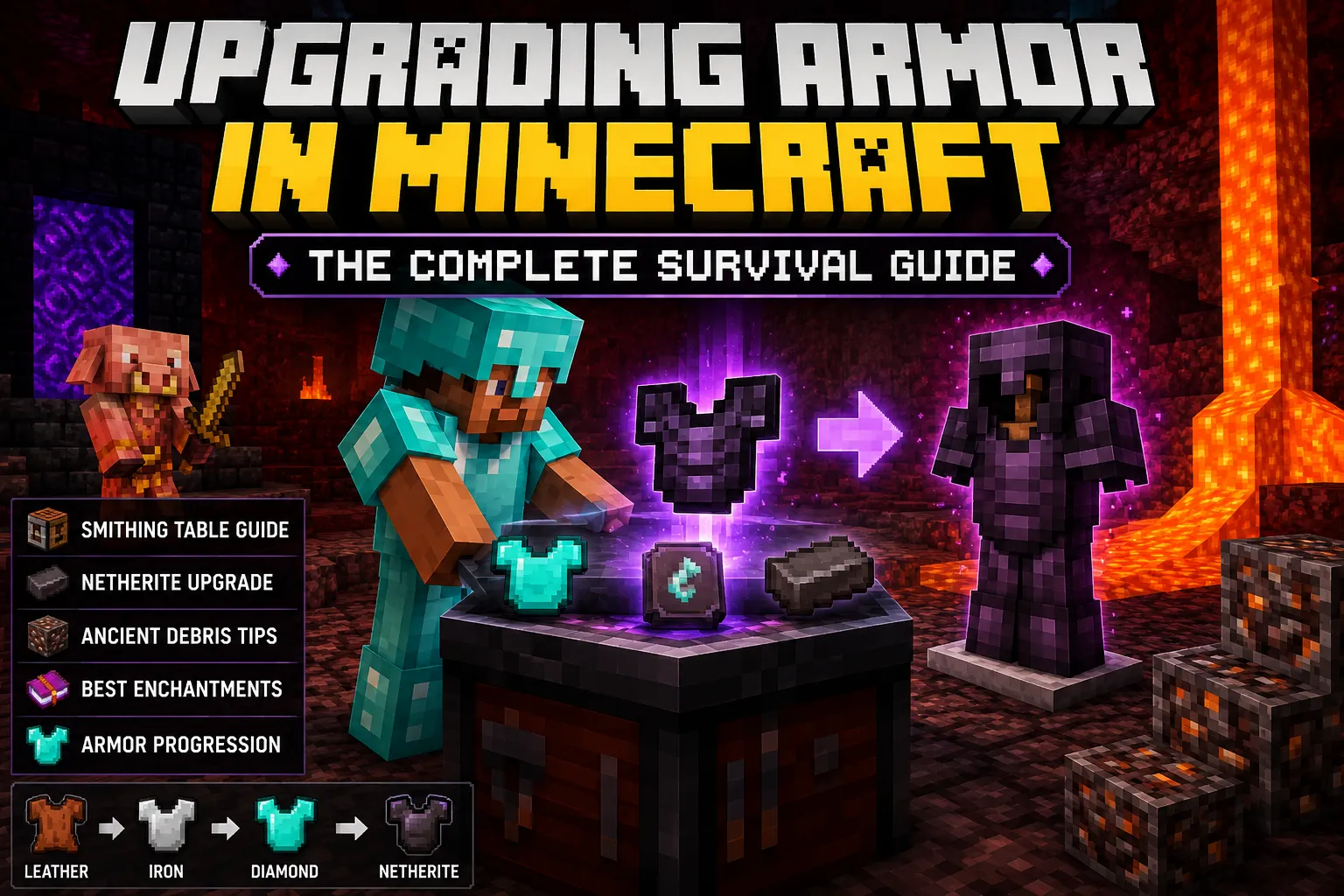
What Armor Upgrading Actually Means in Minecraft
Here's something that trips up a lot of players: there's no "upgrade slot" for most armor tiers. You can't take your iron chestplate, throw it on a Crafting table with a diamond, and get a diamond chestplate. Each tier is crafted from scratch.
The actual upgrade system only applies to one specific transition: diamond gear becoming netherite gear. That's it. That's the only in-game mechanic Mojang calls an upgrade.
Everything else, going from leather to iron, iron to diamond, is a matter of grinding new resources, crafting fresh pieces, and ditching the old set. Your leather boots don't become iron boots. You make iron boots, and you move on.
That said, the full armor progression in Minecraft is a genuine survival journey, and knowing how each tier compares changes how you play.
How do you upgrade armor in Minecraft?
Armor in Minecraft can't be "upgraded" in the traditional sense; for most tiers, you craft each material set separately (leather, iron, gold, diamond). The one true upgrade mechanic is diamond → netherite, done at a Smithing Table using:
-
1x Diamond armor piece
-
1x Netherite Ingot (crafted from 4 Netherite Scraps + 4 Gold Ingots)
-
1x Netherite Upgrade Smithing Template (found in Bastion Remnants)
This process costs zero XP, preserves all enchantments, and produces the strongest armor in the game.
Why It Matters More Than You Think
The difference between leather armor and iron armor isn't cosmetic. Leather gives you 7 armor points across a full set. Diamond gives you 20. Netherite sits at 20 armor points too, but adds armor toughness and knockback resistance that diamond doesn't have.
In practical terms, Iron armor keeps you alive through Creeper blasts that would one-shot you naked. Diamond lets you walk through a pillager raid with some confidence. Netherite makes you survive situations that have no business being survivable, including accidentally walking into lava, since netherite drops don't burn.
There's also the endgame enchantment economy to think about. You don't want to grind out Protection IV on an iron chestplate you'll trash in 10 hours. Knowing when to invest enchantments matters as much as knowing how to get the next tier.
Armor Progression: The Full Tier List
Minecraft armor tiers from weakest to strongest:
-
Leather — Starter tier. Easy to get, barely protects you.
-
Gold — Weird middle tier. High enchantability, terrible durability. Skip it unless you're roleplaying.
-
Chainmail — Can't craft it. Drops from mobs, found in chests, or traded with armorers. Comparable to gold protection-wise.
-
Iron — The real first proper armor. Mine iron, smelt it, craft it. Most players spend the bulk of the early-to-mid game in iron.
-
Diamond — The target for most of the game. Strong, durable, fully enchantable, and the base requirement for netherite.
-
Netherite — The endgame. Requires the Nether, ancient debris farming, and the smithing template system. Absolutely worth it.
Armor Upgrade Comparison Tables
Armor Points (Full Set)
|
Material |
Armor Points |
Armor Toughness |
Knockback Resistance |
|
Leather |
7 |
0 |
0% |
|
Gold |
11 |
0 |
0% |
|
Chainmail |
15 |
0 |
0% |
|
Iron |
15 |
0 |
0% |
|
Diamond |
20 |
8 |
0% |
|
Netherite |
20 |
12 |
40% |
Durability Comparison (Chestplate)
|
Material |
Chestplate Durability |
|
Leather |
80 |
|
Gold |
112 |
|
Chainmail |
240 |
|
Iron |
240 |
|
Diamond |
528 |
|
Netherite |
592 |
Material Requirements (Full Set)
|
Material |
Units Required |
Source |
|
Leather |
24 |
Cows, horses, llamas |
|
Gold |
24 ingots |
Gold ore (Y=-16 best) |
|
Iron |
24 ingots |
Iron ore (any depth) |
|
Diamond |
24 diamonds |
Y=-58 to Y=-64 (best vein spot) |
|
Netherite |
4 ingots + 4 templates |
Ancient Debris + Bastions |
Best Enchantments by Armor Slot
|
Slot |
Priority Enchantments |
Situational |
|
Helmet |
Aqua Affinity, Respiration III, Unbreaking III, Mending |
Blast Protection IV |
|
Chestplate |
Protection IV, Unbreaking III, Mending |
Thorns III |
|
Leggings |
Protection IV, Unbreaking III, Mending |
Swift Sneak III (1.19+) |
|
Boots |
Feather Falling IV, Protection IV, Depth Strider III, Mending |
Frost Walker II |
Getting From Leather to Iron
There's no shortcut here. You mine iron ore, smelt it into ingots, and craft the pieces. Iron ore spawns at basically every underground elevation, but the sweet spot for volume is around Y=16. Strip mining gets you there fast.
You need 24 iron ingots for a complete set. Prioritize the chestplate (8 ingots) and leggings (7 ingots) first; they cover the most body mass and absorb the most damage. Boots (4 ingots) and a helmet (5 ingots) can wait if you're in a rush.
Don't bother enchanting iron armor unless you're going to be in iron for a while. If you're in the early game with no diamond in sight yet, a simple Unbreaking II from a found book is fine. But Protection IV on iron? Save that for something better.
Getting From Iron to Diamond
Same logic, you craft diamond armor fresh. The real challenge is finding enough diamonds. Diamond ore spawns primarily between Y=-58 and Y=-64. That deep. Strip mining at Y=-60 gives you the best exposure to diamond veins while staying above bedrock noise.
You need 24 diamonds for a full set. That's a real investment. Most players hit diamond in phases: chestplate first, then leggings, then helmet, and boots.
A few things that speed up diamond collection:
-
Fortune III on your pickaxe. Each ore can drop 2-4 diamonds instead of 1.
-
Caving in the deep slate layer. Diamond-exposed caves are more common than people realize.
-
Trading with villagers. Expert-level armorers sometimes offer diamond armor directly.
Don't smelt diamond ore with Fortune III active. Raw diamond ore mined with Fortune gives multiple diamonds; smelting it gives exactly one. The block has to be mined, not cooked.
Upgrading Diamond to Netherite
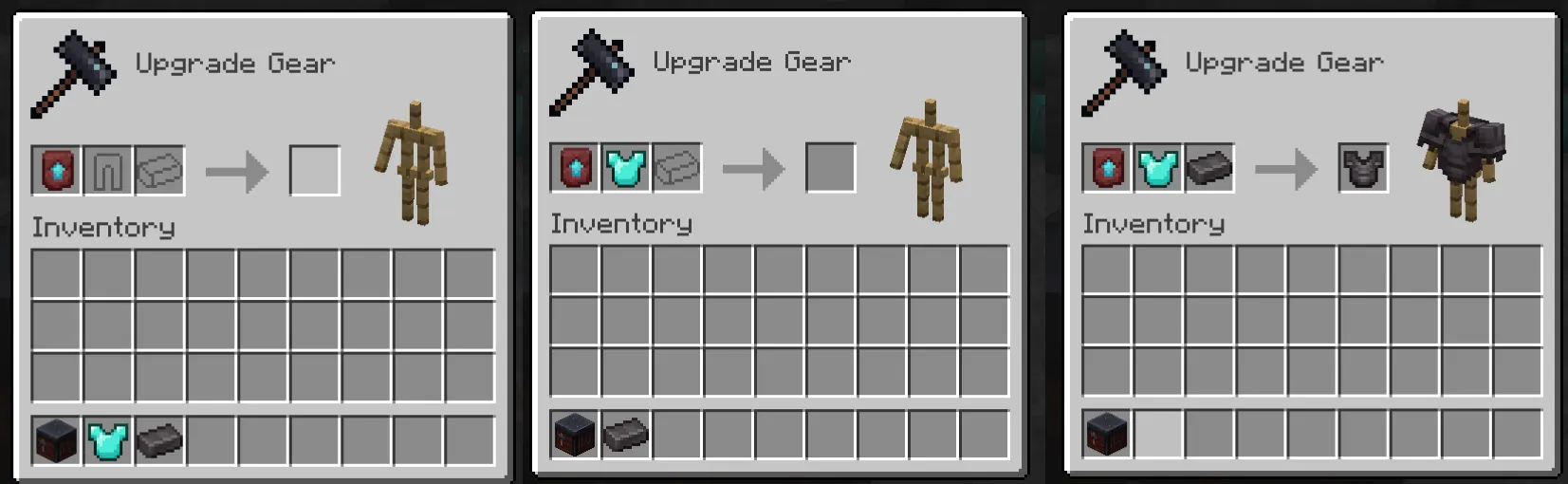
This is where the real upgrade system lives. You're not crafting new armor, you're converting your diamond pieces at a Smithing Table.
Here's what you need for each piece:
-
1x Diamond armor piece (with or without enchantments)
-
1x Netherite Ingot
-
1x Netherite Upgrade Smithing Template
For a full set (helmet, chestplate, leggings, boots): 4 ingots and 4 templates.
Crafting a Netherite Ingot: Smelt Ancient Debris → Netherite Scraps. Combine 4 Netherite Scraps + 4 Gold Ingots = 1 Netherite Ingot. So one full set costs you 16 Ancient Debris and 16 Gold Ingots.
At the smithing table, the slot order is: Template → Diamond Piece → Netherite Ingot. Place them in that order, pull out your netherite piece. That's the entire upgrade process.
How the Smithing Table Works
The smithing table has three input slots. For netherite upgrades:
-
Left slot: Smithing Template (the Netherite Upgrade template specifically)
-
Middle slot: Your diamond armor piece
-
Right slot: Netherite Ingot
What makes this system genuinely good: it costs zero experience. No XP drain. You could have a Protection IV, Unbreaking III, Mending chestplate — throw it in, pull it out as netherite, lose nothing. The enchantments stay. The name stays. The prior work penalty stays (which matters if you've been using an anvil). The exact number of durability points lost also carries over, not the remaining durability.
You can craft a smithing table with 2 Iron Ingots + 4 Wood Planks. It's a simple recipe, and you likely have the materials from day one. You can also find them naturally in village toolsmith houses if you need one before you've set up smelting.
Netherite Upgrade Smithing Template Explained
Since the 1.20 update (Trails & Tales), you can't just throw a diamond gear and a netherite ingot into the smithing table. You need the Netherite Upgrade Smithing Template. A lot of players who last played before 1.20 get blindsided by this.
Where to Find It
Netherite Upgrade Smithing Templates spawn in Bastion Remnants, those dark, gold-lined fortress structures in the Nether. The easiest guaranteed find is the Treasure Room: head down to the bottom of the bastion, find the gold-block room, and there's a chest there with a guaranteed Netherite Upgrade template.
Other bastion chests have a roughly 10% chance of containing one, so it's worth clearing a whole bastion if you're desperate.
How to Duplicate Templates
You only need to find one template, and then you can duplicate it infinitely:
Crafting recipe for duplication:
-
1x Netherite Upgrade Smithing Template
-
7x Diamonds
-
1x Netherrack
Arrange in crafting table → outputs 2 Netherite Upgrade Smithing Templates.
This means once you've raided one bastion and got one template, the diamond cost of duplicating is the only real limit. For a full set, you'll duplicate three times (1 original → 2 → 3 → 4). That's 21 diamonds and 3 netherrack.
Finding and Farming Ancient Debris
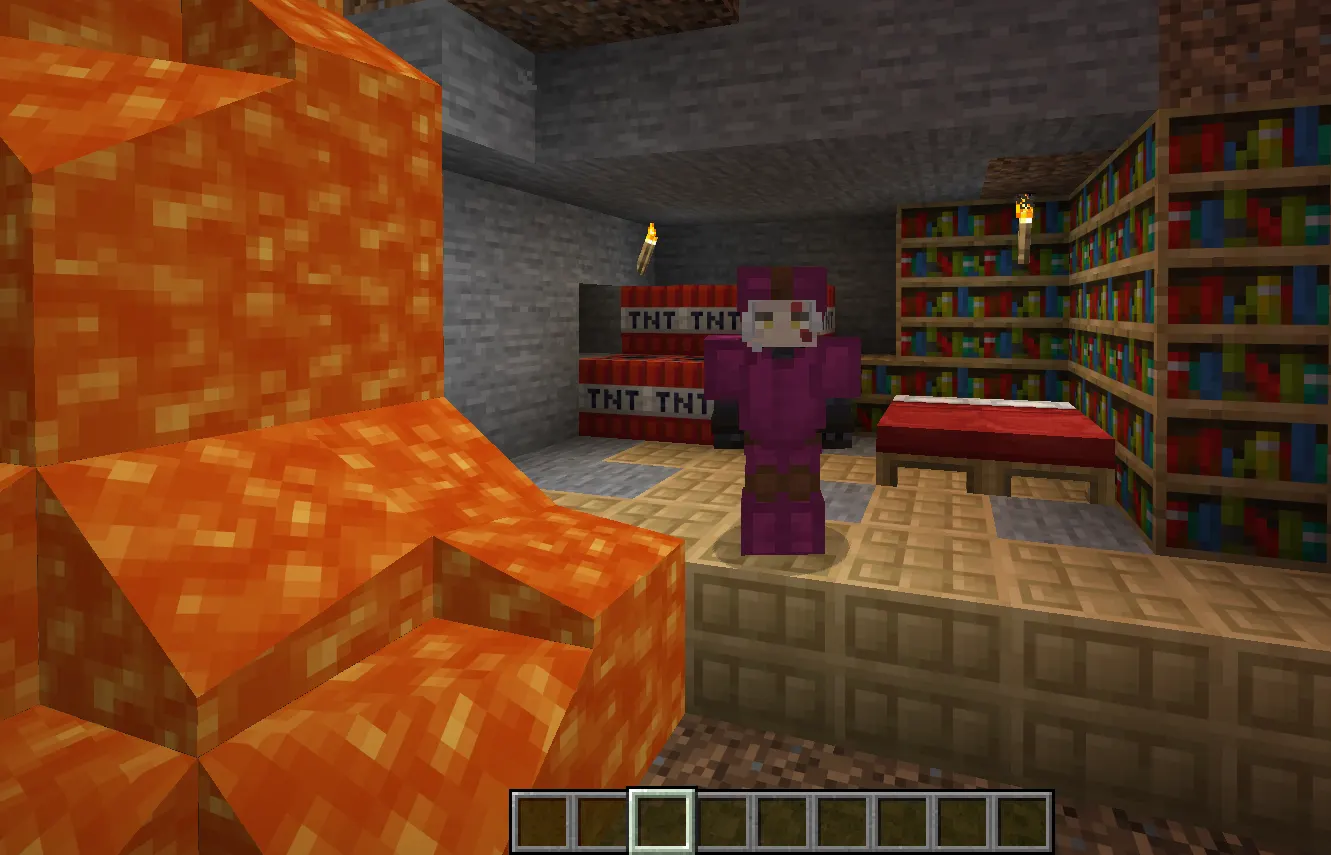
Ancient Debris is the ore you smelt into Netherite Scraps. It only spawns in the Nether, buried in Netherrack. It never generates, so you will always need to dig to it.
Where to Mine
Ancient Debris spawns between Y=8 and Y=22, peaking at Y=15. Set your coordinates display on and strip mine at Y=15 for the best concentration.
It also has a secondary spawn range at Y=8 to Y=119, but the frequency drops sharply. Stick to Y=15.
Mining Methods
TNT blasting is the most efficient method. TNT doesn't destroy ancient debris (it's blast-resistant). Lay corridors, place TNT every 4-5 blocks, detonate. You clear huge amounts of Netherrack fast, and anything Ancient Debris gets left standing.
Bed explosions work the same way and are cheaper. In the Nether, sleeping in a bed causes it to explode. Set a bed in your tunnel, trigger it from cover. Same result as TNT, but beds are free to craft. Just don't catch yourself in the blast.
Strip mining is the slow but steady method. Dig a 1×2 corridor at Y=15. You'll find about 1-3 pieces of Ancient Debris per minute of mining with a fast pickaxe.
Fortune does NOT affect Ancient Debris. Each block always drops one piece. Save your Fortune pickaxe for diamonds and use your regular diamond pickaxe (or netherite if you got tools first) for Nether mining.
How Much You Need
|
Goal |
Ancient Debris |
Gold Ingots |
|
1 armor piece |
4 |
4 |
|
Full armor set |
16 |
16 |
|
Full set + tools |
36 |
36 |
Plan your Nether run accordingly. Bring plenty of fire resistance potions, gold armor for Piglin neutrality, and, at a minimum,m a diamond pickaxe.
Best Enchantments and When to Apply Them
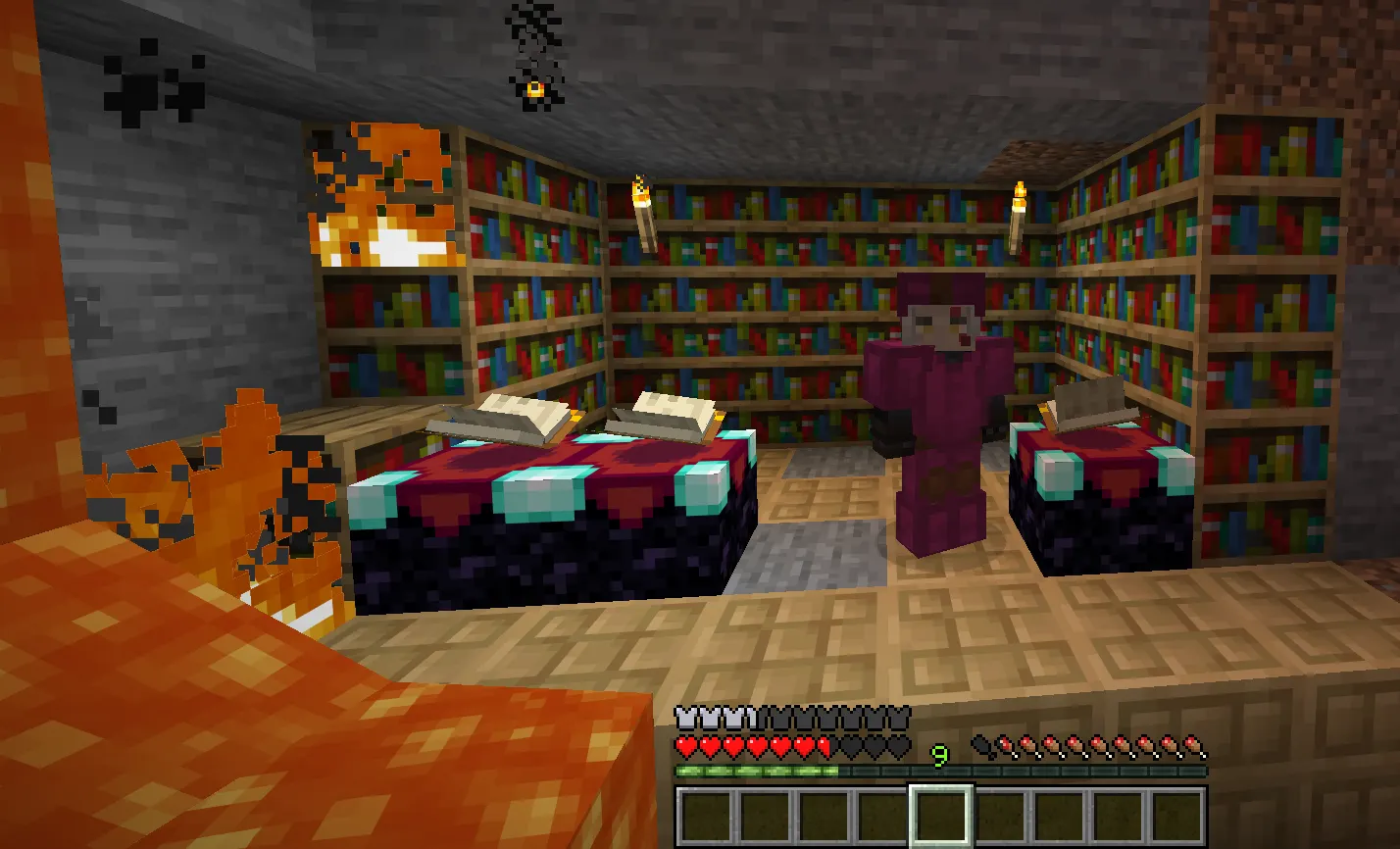
The big question: do you enchant the diamond first, then upgrade to netherite? Or get netherite and then enchant?
Enchant the diamond first. Always.
Netherite ingots are a rare resource. Diamonds are comparatively easier to stack up. If you enchant your diamond armor, upgrade it to netherite, and you keep every enchantment at zero XP cost. The upgrade process doesn't touch your enchantments at all.
If you wait until you have netherite to enchant, you're burning XP on already-rare pieces when you could have done it on diamond.
Priority Enchantments by Slot
Helmet:
-
Aqua Affinity (can't skip this mining underwater without it is painful)
-
Respiration III (underwater breathing)
-
Unbreaking III
-
Mending
Chestplate:
-
Protection IV (highest priority enchantment in the game for general survival)
-
Unbreaking III
-
Mending
Leggings:
-
Protection IV
-
Unbreaking III
-
Mending
-
Swift Sneak III (1.19+ — huge for sneaking in deep dark, archaeology, etc.)
Boots:
-
Feather Falling IV (non-negotiable — fall damage is still a top cause of death)
-
Protection IV
-
Depth Strider III (or Frost Walker II if you want the ice walking gimmick)
-
Unbreaking III
-
Mending
-
Soul Speed III (for fast Nether travel — pairs perfectly with a netherite set)
Why Mending Is So Important
Mending repairs your armor using XP orbs. With Mending on all four pieces, your netherite set is effectively permanent, killing mobs, getting XP, and armor repairs itself. Without Mending, you're eventually crafting new diamond pieces to upgrade again.
You can't get Mending from an enchanting table. It only comes from fishing, chests, trades with librarian villagers, or treasure. Trading with a librarian is the most reliable method to reset their job block until one offers Mending.
What Transfers During Upgrades
When you upgrade diamond to netherite at the smithing table, here's exactly what carries over:
|
Property |
Transfers? |
Notes |
|
All enchantments |
✅ Yes |
Every enchantment, every level |
|
Custom name (anvil) |
✅ Yes |
Your item keeps its name |
|
Prior work penalty |
✅ Yes |
Anvil cost history stays the same |
|
Durability lost |
✅ Yes |
Same number of durability points lost |
|
Remaining durability |
❌ No |
Recalculated from netherite max |
|
Armor trims |
✅ Yes |
Visual trims carry over intact |
The durability point is worth explaining: if your diamond chestplate has taken 100 durability damage, your netherite chestplate starts with 100 durability damage. But netherite has higher max durability, so the remaining percentage is actually better than before. Your beat-up diamond chestplate becomes a slightly-worn netherite chestplate.
Java vs Bedrock Differences
Most of the mechanics above apply to both editions, but there are real differences:
|
Feature |
Java Edition |
Bedrock Edition |
|
Netherite upgrade requires a template |
Yes (1.20+) |
Yes (1.20+) |
|
Smithing table UI layout |
Template → Gear → Material |
Same |
|
Netherite item fire immunity |
Items (dropped) only |
Items (dropped) only |
|
Gold armor Piglin neutrality |
Yes |
Yes |
|
Armor enchantment table max |
30 bookshelves |
15 bookshelves (same cap) |
|
Knockback resistance cap |
100% |
100% |
|
Swift Sneak availability |
Yes (1.19+) |
Yes |
Both editions follow the same core progression. The 1.20 Smithing template requirement hit Bedrock and Java simultaneously, so any pre-1.20 guide telling you to just combine diamond + netherite ingot is outdated.
Beginner Mistakes That Cost You Everything
Enchanting iron armor with expensive enchantments. Iron armor is temporary. If you spend 30 levels and a Protection IV book on iron, that investment dies when you smash it into a crafting table for diamond parts. Enchant diamond.
Skipping the Bastion. Some players rush to ancient debris without stopping at a Bastion first. You need the Netherite Upgrade Template before the ingots are usable. Hit the Bastion first, ideally the Treasure Room, before you even start serious debris mining.
Mining Ancient Debris with Fortune. Fortune does nothing on ancient debris. This is a common misconception. Mine it with whatever diamond pickaxe you have.
Going to the Nether without gold armor. Piglins attack on sight unless you're wearing at least one piece of gold armor. A gold helmet costs 5 gold ingots and saves your life in every bastion raid. Wear it.
Applying armor trims before upgrading. Trims are cosmetic and carry over when you upgrade. But you're spending materials on diamond gear you're about to convert. Wait until you have netherite before you decorate.
Forgetting fire resistance potions. You can make netherite immune to fire in your inventory and dropped on the ground, but YOU still burn in lava. A stack of fire resistance potions makes ancient debris mining dramatically safer.
Best Order to Upgrade Your Gear
If you're planning a full endgame progression run, here's the sequence that makes the most sense:
-
Get full iron armor — Immediate survival baseline.
-
Find and enchant an iron or diamond sword — You need XP farms working early.
-
Mine 24 diamonds — Priority: chestplate, leggings, helmet, boots.
-
Enchant your diamond armor — Protection IV everywhere, Feather Falling boots, Aqua Affinity helmet.
-
Go to the Nether — Find a Bastion, clear the Treasure Room, grab the template.
-
Duplicate the template 4x.
-
Farm ancient debris to 16 pieces, smelt to 16 scraps, craft 4 netherite ingots.
-
Upgrade each piece at the smithing table.
-
Get Mending from a librarian villager. Apply to all four pieces.
The chestplate is the highest priority upgrade because it absorbs the most damage. If you can only afford one netherite upgrade right now, make it the chestplate.
Fastest Path to Endgame Armor
Speed running to netherite? Here's how experienced players shorten the timeline:
Start with a stronghold or village raid for iron. Villages have iron in chests, blacksmiths have iron and sometimes diamonds. A buried treasure chest from a treasure map can give you up to 5 diamonds directly.
Don't strip mine for diamonds in the overworld. Caving in the deep slate layer around Y=-60 is genuinely faster than strip mining in most seeds. Diamond veins are more exposed, and you pick up iron and gold on the way.
Set up a Piglin bartering station. Throw gold ingots at Piglin,s and they'll drop items randomly, including Netherite Upgrade Smithing Templates occasionally. Not reliable, but worth setting up while you mine.
Use beds for ancient debris. Beds cost 3 wool + 3 wood planks. Sheep are everywhere. This is free TNT that you can mass-produce in minutes.
Blast Furnace for smelting. Smelts at 2x speed. You need 3 smooth stones, 1 furnace, and 5 iron ingots. Build one before your first Nether run.
Endgame Survival Tips for Netherite Armor
Getting netherite is one thing. Keeping it and making it permanent is another.
Mending is your top priority. Once all four pieces have Mending, treat every mob fight as armor maintenance. XP drops repair your gear passively.
Repair before enchanting at an anvil. If a piece is damaged and you want to add enchantments via a book, repair it first. The anvil's prior work penalty compounds fast.
Store one duplicate template. After upgrading your full set, keep one extra Netherite Upgrade Template in your chest. If you get gear with insane enchantments from fishing or trading, you'll want it ready.
The chestplate absorbs ~32% of all damage. Helmet takes ~16%, leggings ~24%, boots ~16%. If you're farming XP through combat, expect the chestplate's Mending to trigger most often.
Netherite doesn't make you invincible. A full enchanted netherite set still can't absorb a warden hit fully. Netherite with Blast Protection IV is what you want for the End and for Wither fights specifically.
Armor toughness is underrated. The 12 total toughness on netherite means high-damage hits (8+ damage from strong mobs) do proportionally less than they would against diamond's 8 toughness. Against normal enemies, the difference is minimal. Against bosses, it adds up.
Final Verdict
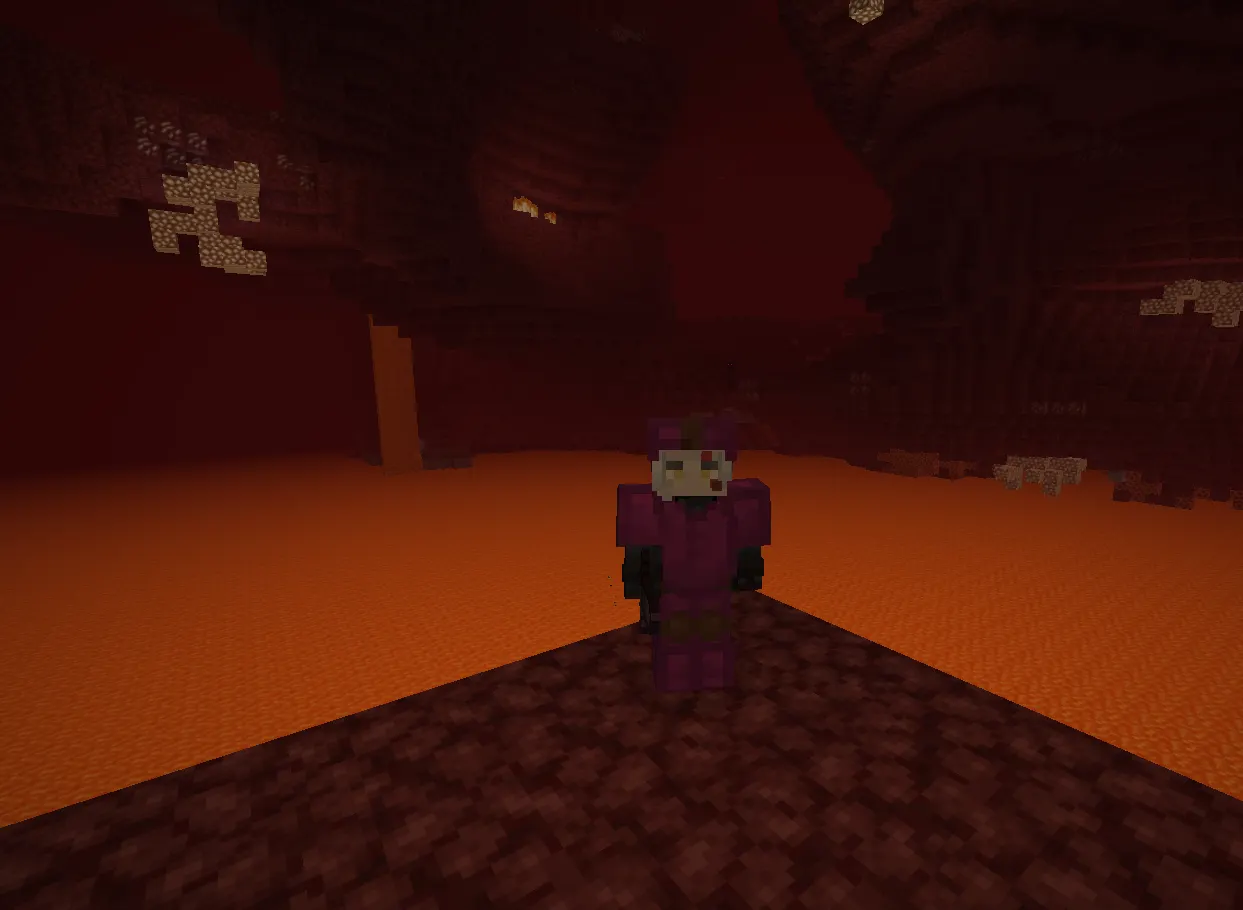
Armor progression in Minecraft is a gradual process with one real upgrade mechanic at the end. Most of the journey, from leather to gold to iron to diamond, is just Crafting new sets from better materials. The only true upgrade happens at the smithing table when diamond becomes netherite.
That transition is worth every step. The lava-immunity on drops alone has saved countless endgame sets from disaster. The toughness improvement matters in boss fights. The knockback resistance changes PvP. And Mending on a netherite set effectively gives you armor that lasts forever.
If you're planning your path: enchant diamond first, raid a Bastion for the template, farm Y=15 for ancient debris, and don't forget fire resistance potions. The full netherite grind is a legitimate achievement; it should feel like one.