
Automatic Sugarcane Farm in Minecraft: Best Easy Design (2026)
If you've ever walked a row of sugarcane snapping each stalk by hand, you already know why this farm exists. Sugarcane is everywhere in the mid-to-late game (paper, books, bookshelves, rockets, trading), and manually restocking it gets tedious fast. An observer-and-piston farm fixes that permanently: build it once, and it keeps producing whether you're mining, exploring, or logged off entirely (as long as the chunk stays loaded on a server).
This is the standard, beginner-friendly version of the farm. It's not the fastest design in the game. Zero-tick and flying-machine builds push more cane per hour, but this one is the version that actually gets finished, since it uses common materials, has almost no failure points, and takes maybe fifteen minutes to set up per row.
What Is the Easiest Automatic Sugarcane Farm in Minecraft?
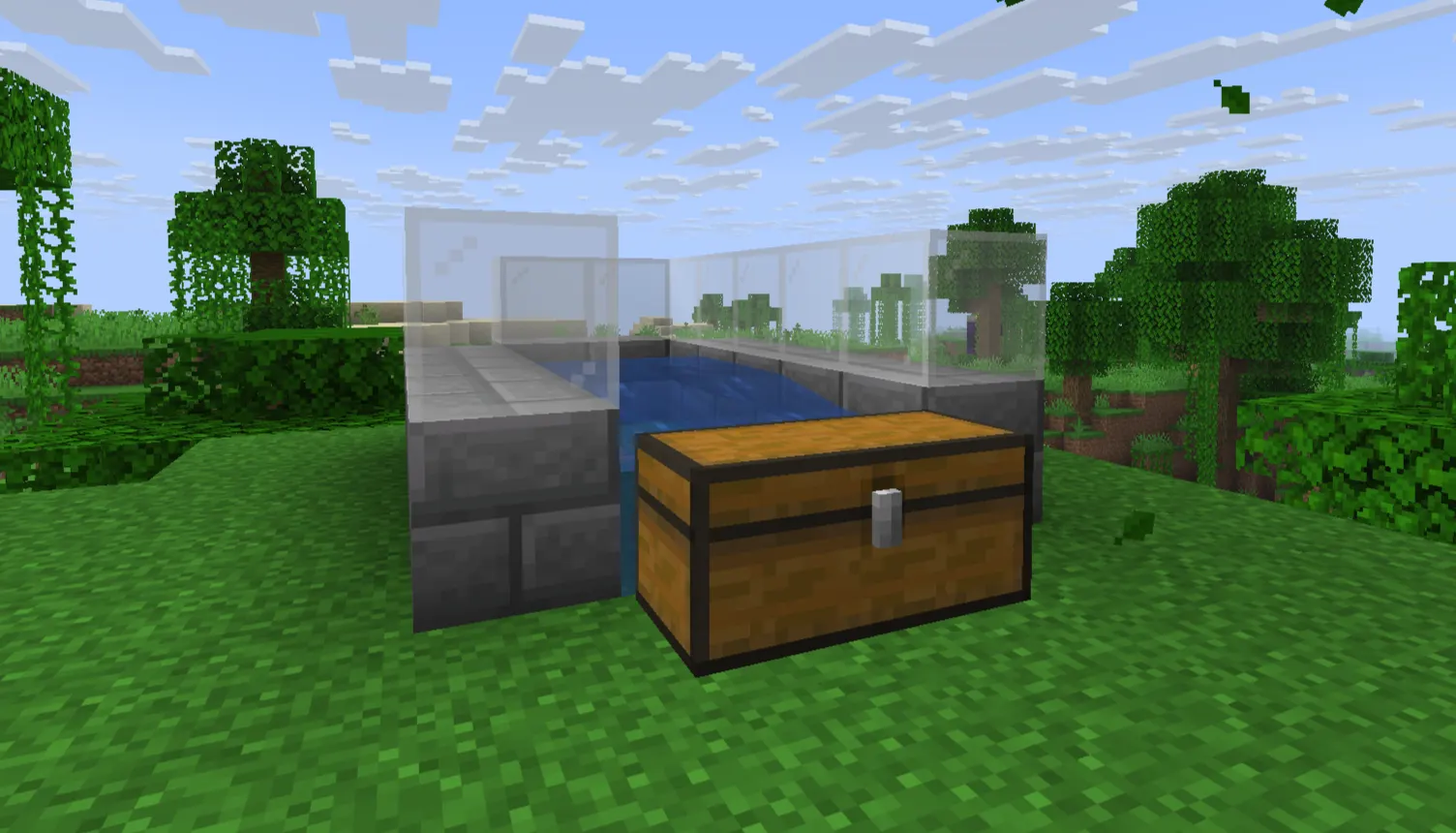
The easiest automatic sugarcane farm uses one piston and one observer per sugarcane stalk. The piston sits at the second-block height facing the cane; the observer sits directly behind or on top of the piston, facing the spot where the third block will appear. When the cane grows to full height, the observer fires, the piston knocks off the top blocks, and a water channel underneath sweeps the drops into hoppers and a chest. It works on both Java and Bedrock with no edition-specific parts.
The whole build is four blocks tall per column: a water channel at the bottom, the block the cane is planted on, the piston, and the observer. Multiply that by however many columns you want and feed them all into the same collection trench.
Materials Needed
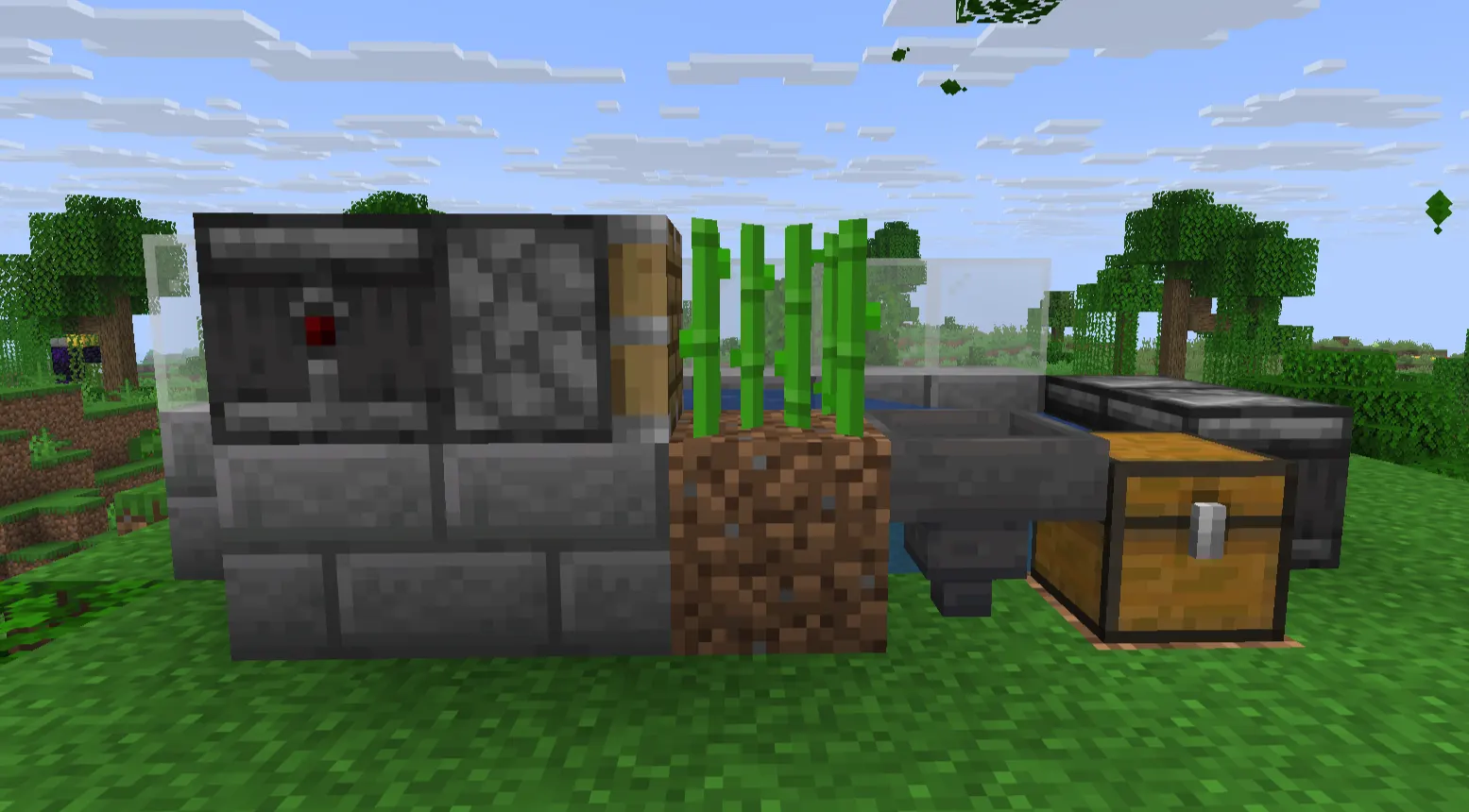
Required materials
|
Item |
Approx. quantity |
Purpose |
|
Sugarcane |
1 per column (to start) |
The crop itself, replant once and it regrows on its own |
|
Regular pistons |
1 per column |
Breaks the grown cane |
|
Observers |
1 per column |
Detects growth and triggers the piston |
|
Redstone dust |
1–2 per column |
Connects observer to piston (only needed if they're not touching) |
|
Sand, dirt, or grass blocks |
1 per column |
What the sugarcane is planted on |
|
Water |
1 source block per channel |
Keeps the cane alive and carries drops to storage |
|
Hoppers |
1–3 per farm, more for wide farms |
Collects drops from the water channel |
|
Chest |
1 (double chest recommended) |
|
|
Any solid block |
A few |
Housing for the piston/observer columns |
Optional materials
-
Glass or slabs, if you want to see into the mechanism or block mobs from wandering in
-
A hopper minecart and rail, if you're building a very wide farm where a straight hopper line gets expensive
-
Extra chests, if you're running more than four or five columns
Don't overbuy. This design doesn't need dispensers, comparators, or repeaters. The observer's pulse is strong enough to fire a piston directly in almost every layout.
Before You Build
Pick a flat spot with easy access to water: a shoreline, a river, or just a dug-out trench you fill yourself. You don't need natural water nearby; a single water bucket source block handles an entire row.
A few things that actually matter:
-
Space: each column needs about 4 blocks of vertical room and 1 block of width. A ten-column farm is a long, thin structure, so plan for that footprint before you start digging.
-
Proximity to base: sugarcane doesn't need light to grow, so you can build this underground, in a basement, or right next to your main base. There's no farming-distance penalty for sugarcane the way there is for some other crops.
-
Chunk loading: growth only happens in loaded chunks. If you're on a single-player world and stay nearby (or use chunk loaders on a server), the farm keeps running. Walk far enough away and it just pauses until you're back in range.
-
Lighting: not required. Sugarcane grows in total darkness, any Biome, any dimension, as long as it's on a valid block next to water.
Step-by-Step Build Guide
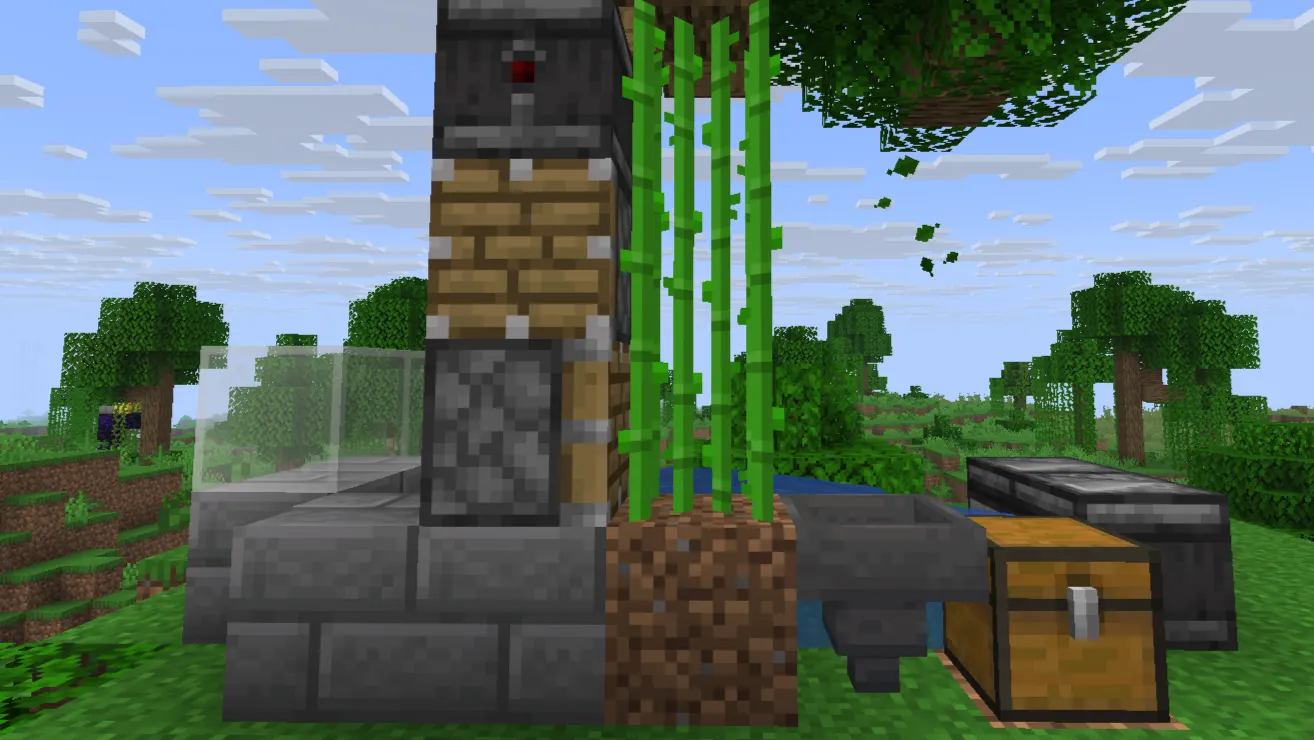
This walks through one column. Repeat it side by side for more output.
1. Dig a one-block-deep trench where your collection channel will run. Make it as long as the number of columns you're planning, plus one extra block at the end for the hopper.
2. Place a water source block at the far end of the trench (the end away from your hoppers). Let it flow down the trench toward the collection point. This water does double duty: it keeps every planted block wet and it sweeps drops toward your hoppers.
3. Place hoppers at the near end of the trench, facing into a chest. If you're running several columns, angle the trench so all the water funnels toward one collection point rather than building a hopper under every column.
4. On the block beside the trench (one block up from the trench floor, so it sits at water level), place your planting block: sand, dirt, or grass all work. This block needs to touch the water horizontally. If it doesn't, the cane you plant on it will pop off instantly.
5. Plant one sugarcane on that block.
6. One block above the planting block, place a regular piston. Face it toward the sugarcane column, so the piston head is pointed at where the second cane block will grow. Use a standard piston here, not a sticky one; a sticky piston will try to pull the broken block back instead of just letting it drop.
7. Directly behind the piston (or on top of it, whichever fits your build), place an observer. The observer's face, the side with the "eye" texture, needs to point at the block position where the cane's third segment will appear, which is one block above the piston. This is the part people get backward most often: the flat side with the dot is the sensor, and that's the side that has to face the cane, not the piston.
8. Connect the observer's back to the piston with Redstone dust if they aren't already touching. Observers push a strong signal, so in most compact builds they can sit right against the piston with no dust needed at all.
9. Bone meal the sugarcane (Bedrock only, since bone meal does nothing to sugarcane on Java) or just wait for it to grow naturally. Watch for the piston to fire once the stalk reaches full height.
10. Repeat columns 4 through 9 along the trench for as many stalks as you want, then check that every column's item drops actually land in the water and flow toward your hoppers.
How the Automatic Farm Works
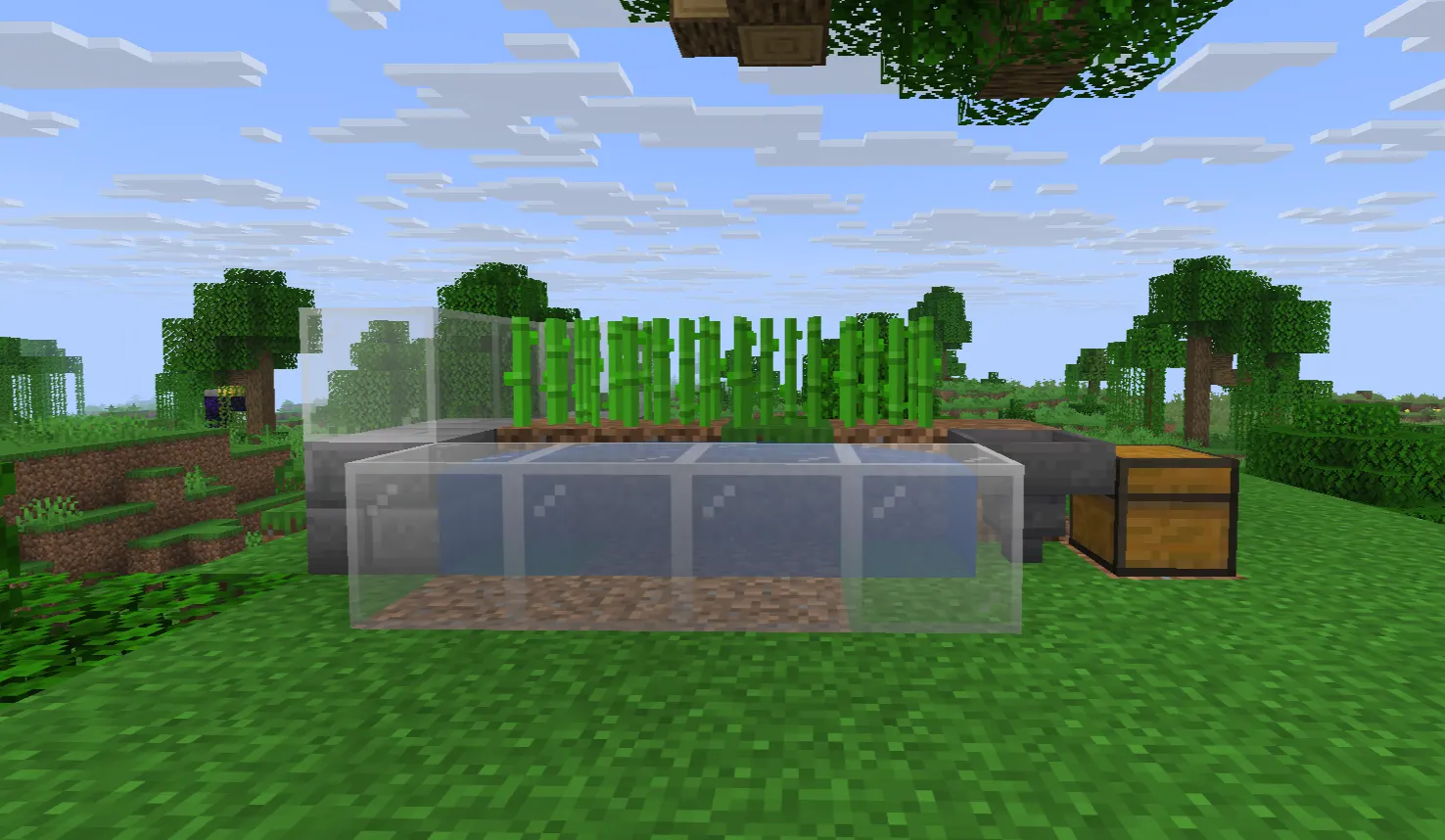
Sugarcane grows from the bottom up, capped at three blocks tall. Growth isn't on a timer. It's driven by random ticks, the same background system that spreads grass and ages saplings. Each block has to accumulate a number of these random ticks before it advances a stage, which is why growth feels unpredictable rather than metronomic.
The observer is just watching one specific spot: the position where the top block of cane appears. The moment that block exists, the observer registers the change and fires a single redstone pulse out its back. That pulse is short, about a tenth of a second, but it's more than enough to trigger a regular piston.
The piston extends, knocks the top two blocks of cane off the stalk, and retracts as soon as the observer's pulse ends. Those two blocks drop as items, fall into the water below, and get pushed along the current until a hopper picks them up. The bottom block of cane, the one actually planted on your sand or dirt, is untouched. It immediately starts regrowing toward that same third-block position, and the cycle repeats without you doing anything.
Farm Size and Expansion
The single-column version above is really a proof of concept. Most players run five to fifteen columns side by side, all draining into one water channel.
A few things to know before scaling up:
-
More columns means more total output, but each individual stalk still grows at the same rate. You're not making cane grow faster, just running more of it in parallel.
-
A single hopper can bottleneck a wide farm. If you've got more than four or five columns dumping into one collection point, consider splitting the trench into two shorter channels feeding two separate hopper lines, or using a hopper minecart under a long trench instead.
-
Shared collection is fine. You don't need a chest per column. One double chest fed by a couple of hoppers easily keeps up with a dozen columns' worth of stalks, since sugarcane doesn't grow that fast to begin with.
-
Height matters if you're stacking farms. You can build a second row of columns above the first with a separate water channel, but leave enough clearance that pistons on the upper row don't interfere with observers below.
Don't expect a wall of forty columns to overwhelm your storage in an afternoon. Growth speed is still the limiting factor, not redstone.
How Fast Does an Automatic Sugarcane Farm Produce?
Slower than people expect, honestly. Sugarcane growth is random-tick driven, and at the default random tick speed, a single stalk advances one block roughly every 15–20 minutes on Java. Bedrock's random tick behavior runs noticeably slower for this crop, so the same single-stalk build produces less over the same stretch of time on that edition.
That means:
-
One column, left alone, gives you maybe two to four sugarcane an hour.
-
Ten columns scale that roughly linearly, since each stalk grows independently, so you're looking at a stack or two over a few hours of real play, not an instant full chest.
-
Production isn't perfectly steady. Random ticks are, well, random. You'll get quiet stretches and sudden bursts, not a clean drip every sixty seconds.
If a tutorial promises a specific "X sugarcane per minute" number without mentioning random tick speed and column count, treat it as a rough estimate at best. The honest version is: build more columns if you want more cane, and don't expect this design to outproduce the time it takes to just walk out and harvest a big manual field once in a while.
What Is Sugarcane Used For?
The main reason to automate this crop instead of just planting a manual field:
-
Paper: needed constantly for books, maps, banner patterns, and cartography tables
-
Books and bookshelves: bookshelves are the backbone of a good enchanting setup, and each one eats three books, each book eating three paper
-
Sugar: used in cakes, pumpkin pie, and several potions, including Swiftness
-
Trading: librarian villagers buy paper in bulk, making a sugarcane farm an indirect emerald source
-
Fireworks (through paper): rocket Crafting needs paper, so a steady cane supply keeps your firework production unblocked tool.
If your only use for sugarcane is the occasional book, you probably don't need this farm at all. Just plant a row and harvest by hand. It earns its keep once you're running an enchanting library, a villager trading hall, or heavy firework use for Elytra flight.
Common Problems and Fixes
Sugarcane is not growing. Check that it's actually touching water horizontally, not diagonally and not below it, but on one of the four adjacent sides. If the water was removed or drained, the cane will have already popped off; you'll need to replant.
Pistons are not activating. Confirm the observer and piston are actually connected, either touching directly or linked with redstone dust. Also check the piston isn't obstructed by another block in its extension path.
Observer is not detecting growth. This is almost always orientation. The observer's sensor face has to point at the block position where growth happens, not at the piston and not at empty air one row off. Break and replace it facing the correct direction if you're unsure.
Sugarcane breaks but items are not collected. Look at your water flow direction. Items only get pushed the way the current is moving. If the trench is flat or the source block is on the wrong end, drops will just sit there instead of traveling to your hoppers.
Farm works inconsistently. This is usually just random tick variance, not a bug. If it's more than that, check whether you're standing far enough away that the chunk has unloaded. No random ticks happen in unloaded chunks, so the farm effectively pauses.
Farm works on Java but seems off on Bedrock (or vice versa). The redstone logic is identical on both editions. The real difference is growth speed (sugarcane advances slower on Bedrock at the same settings) and that bone meal instantly grows sugarcane on Bedrock but does nothing to it on Java.
Chest or hopper fills incorrectly. If items stop collecting after a while, your chest is probably full. Double chests buy you a lot more headroom than a single chest if you're running more than a handful of columns.
Common Building Mistakes
-
Placing the observer facing the piston instead of the cane
-
Using a sticky piston instead of a regular one
-
Planting sugarcane on a block that isn't touching water
-
Letting the water channel flow away from the hoppers instead of toward them
-
Forgetting that pistons need a clear block to extend into
-
Building columns too close together so pistons collide with neighboring redstone
-
Skipping a double chest and then wondering why the farm "stopped working"
Java vs. Bedrock
|
Feature |
Java Edition |
Bedrock Edition |
|
Observer-piston mechanic |
Same |
Same |
|
Bone meal on sugarcane |
No effect |
Instantly grows the cane |
|
Growth speed (same settings) |
Faster |
Noticeably slower |
|
Redstone wiring |
Identical |
Identical |
The build itself doesn't change between editions: same piston placement, same observer direction, same water channel. The practical difference is growth rate and the bone meal shortcut on Bedrock, which is genuinely useful if you want to nudge a stalk along instead of waiting.
Is This the Best Sugarcane Farm?
Depends what you're optimizing for. Against zero-tick or flying-machine designs, this build loses on raw output. Those setups can push over a thousand cane per hour per plant using tricks like forcing multiple growth Updates in a single game tick. They're also more expensive, fussier to get right, and genuinely easy to break if you misplace one block.
For a typical Survival world, this observer-piston version wins on the things that matter more day to day: it's cheap, it's forgiving if you mess up a placement, and it's trivial to expand by just adding another column. You can build it your first week in a world and never have to think about it again.
If you're running a huge enchanting hall or a server with dozens of players buying paper off you, look into a zero-tick design once you've got redstone experience. For everyone else, this is the one to build.
Final Verdict
This is the farm to build if you want a reliable, low-maintenance cane supply without turning it into a redstone project. One piston, one observer, a water channel, and a chest: that's the entire parts list, and once it's running you genuinely never have to touch it again.
It's not the fastest design out there, and if you're chasing maximum output for a big trading setup, a zero-tick or flying-machine build will outproduce it several times over. But for keeping your book supply topped up, your enchanting library stocked, and your firework crafting unblocked, this is more than enough. It's the version you'll actually finish building instead of abandoning halfway through.