Best Villager Trades in Minecraft by Profession (2026 List)
Every Survival world eventually turns into a villager economy. You find a village, someone becomes a farmer, and within a week you're breaking blocks to reassign jobs because you realized your fletcher is worth more than your entire Iron farm.
There isn't one "best" villager. A librarian selling Mending is worth more than gold to a player who just lost their third pair of diamond boots to lava, but that same villager does nothing for someone who needs ender pearls for an End trip. The right profession depends entirely on what you're trying to solve.
Quick answer: for pure emerald income, fletchers and farmers are the easiest to set up. For gear, the smith trio (Armorer, Toolsmith, Weaponsmith) gets you enchanted diamond equipment without touching an anvil. For long-term value, nothing beats a librarian, because Mending is the one enchantment that makes gear last indefinitely.
This guide covers all 13 working professions, how trading actually works under the hood, what's still experimental versus what's live in the default game, and how to build a trading setup that doesn't turn into a maintenance chore.
Quick Answer: Best Villager Trades at a Glance
|
Profession |
Best Trade |
Main Benefit |
Best For |
|
Librarian |
Enchanted books (Mending, Unbreaking, Efficiency) |
Gear that repairs itself, no enchanting table needed |
Anyone past early game |
|
Fletcher |
Sells arrows for sticks |
Cheapest, fastest renewable emerald source |
Beginners, emerald farming |
|
Cleric |
Ender pearls for rotten flesh |
Renewable End access without Endermen hunting |
Mid-to-late game, zombie farm owners |
|
Farmer |
Bread/cake for crops |
Turns a Wheat farm into an emerald machine |
Beginners with a crop farm |
|
Armorer / Toolsmith / Weaponsmith |
Enchanted diamond gear |
Full equipment set without mining Diamonds |
Gearing up fast |
|
Cartographer |
Explorer maps (mansion, monument) |
Only reliable way to locate those structures |
Loot-focused players |
|
Mason |
Terracotta, quartz, polished stone |
Bulk building materials for cheap |
Builders |
|
Shepherd |
Dyed wool, beds, banners |
Decoration on demand |
Builders, redecorating |
|
Fisherman |
Enchanted fishing rod (Master) |
Passive income if you already fish |
Fish farm owners |
|
Butcher |
Cooked meat, rabbit stew |
Food from an animal farm |
Ranchers |
|
Leatherworker |
Saddle (Master) |
The only reliable non-loot saddle source |
Horse and boat builds |
That last column matters more than any ranking. Don't build a full trading hall on day one. Pick the profession that solves your current problem, then expand.
How Villager Trading Works
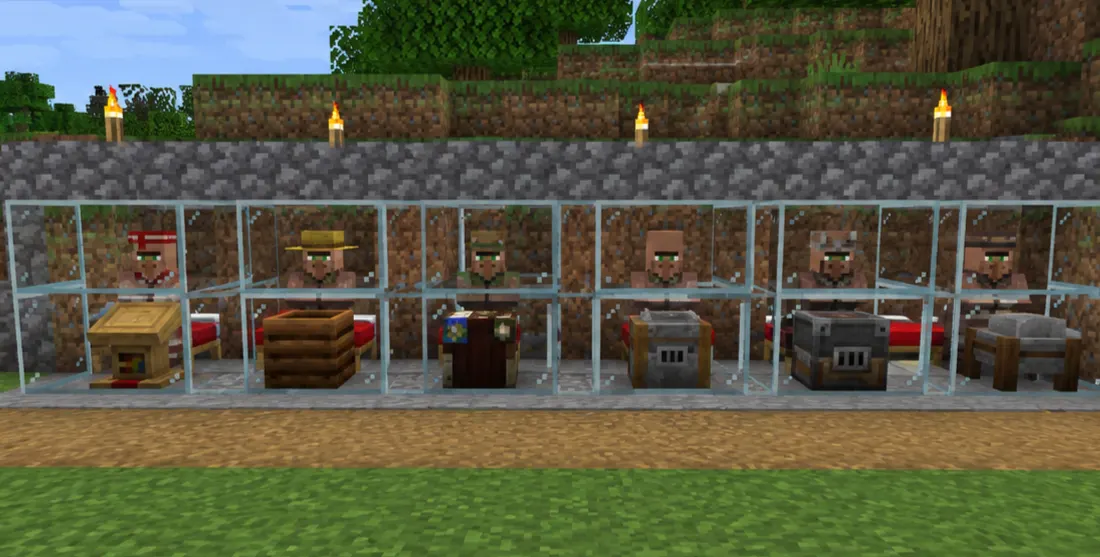
Every villager can hold one of 13 jobs, plus two non-working states: Unemployed and Nitwit. A villager becomes Unemployed if it can't find a job site block, and it stays that way, wandering the village, contributing nothing, until you place the right block nearby.
Assigning a profession is indirect. You place a job site block (a lectern, a composter, a blast Furnace, whatever matches the job you want) within range of an unemployed adult villager, and the villager claims it on its own during the day. You can't force a specific villager to take a specific job by clicking anything. If a villager claims the wrong block first, break that block, wait for the job to clear, then place the block you actually want.
Once a villager makes its first trade with you, the job locks. Breaking the workstation after that point won't change its profession, though it will stop the villager from leveling up further until you replace the block.
Villager experience and levels work in five tiers: Novice, Apprentice, Journeyman, Expert, and Master. Each trade you complete gives the villager XP, and enough XP pushes them to the next tier, unlocking a new trade slot. A fresh villager only offers its Novice trades. You won't see enchanted books, diamond gear, or ender pearls until the villager has leveled up through actual use.
Restocking happens when a villager visits its workstation, typically once or twice a day, and refreshes the number of times you can use its current trades. If a villager can't reach its workstation, whether from a blocked path, a destroyed workstation, or being stuck somewhere, it stops restocking and you'll burn through its trade uses fast.
Demand and pricing aren't fixed. Buy the same trade repeatedly in one visit and the price climbs, because the game tracks demand and adds it back onto the emerald cost. Let the villager restock before buying in bulk again, and prices drop back down.
How to Get the Best Villager Trades
A few habits separate a trading hall that actually works from one you keep fighting with.
Check trades before locking them in. A villager's Novice-tier offer is randomized. If a librarian's Novice trade is something forgettable, you're not stuck. The lectern trick fixes that.
Use the lectern reroll for librarians. Break the lectern before you've traded with the villager, then place a new one. This resets the villager to Unemployed and back to Librarian with a freshly rolled set of trades. Once you've made an actual trade with that villager, the offers lock and rerolling stops working on it.
Keep workstations reachable. A villager that can't pathfind to its job block won't restock, won't level up, and will eventually just sit there being useless. Build your trading hall so every villager has a clear, short walk to its block.
Give every villager a bed. Villagers need to sleep to count as having a valid "home," and a villager without a bed can behave unpredictably, including wandering off or failing to restock properly. One bed per villager, no exceptions.
Cure a zombie villager instead of killing it. Weakness potion, then a golden apple, gives you a permanent reputation boost with that villager worth a real discount on every future trade. It's a one-time bonus. Curing the same villager again doesn't stack further discounts, no matter what old guides claim.
Stack Hero of the Village on top, not instead. Defeating a raid gives you a temporary buff that further discounts trades across the whole village while it's active. It fades over time, so it's best used for a big shopping trip, not as your everyday discount.
Don't overbuy in one sitting. Demand pricing punishes bulk buying. Spread purchases across restocks if a trade starts getting expensive mid-session.
Farmer — Best for Food and Early Emerald Income
Workstation: Composter
Farmers are the easiest villager to make profitable, because the raw materials are things you're already growing. Buy up your surplus wheat, potatoes, carrots, and beetroot, and the farmer sells you bread, cake, pumpkin pie, cookies, and at higher tiers, golden carrots and glass bottles.
If you're playing survival with even a modest crop farm, this is the profession to set up first. There's no combat requirement, no mining, no travel. Plant, harvest, sell the excess. A large wheat farm feeding a couple of farmers can produce a steady trickle of emeralds without you doing anything except walking past every so often.
The ceiling here is lower than a fletcher or librarian, but the floor is the lowest in the game. Anyone can do this on day two.
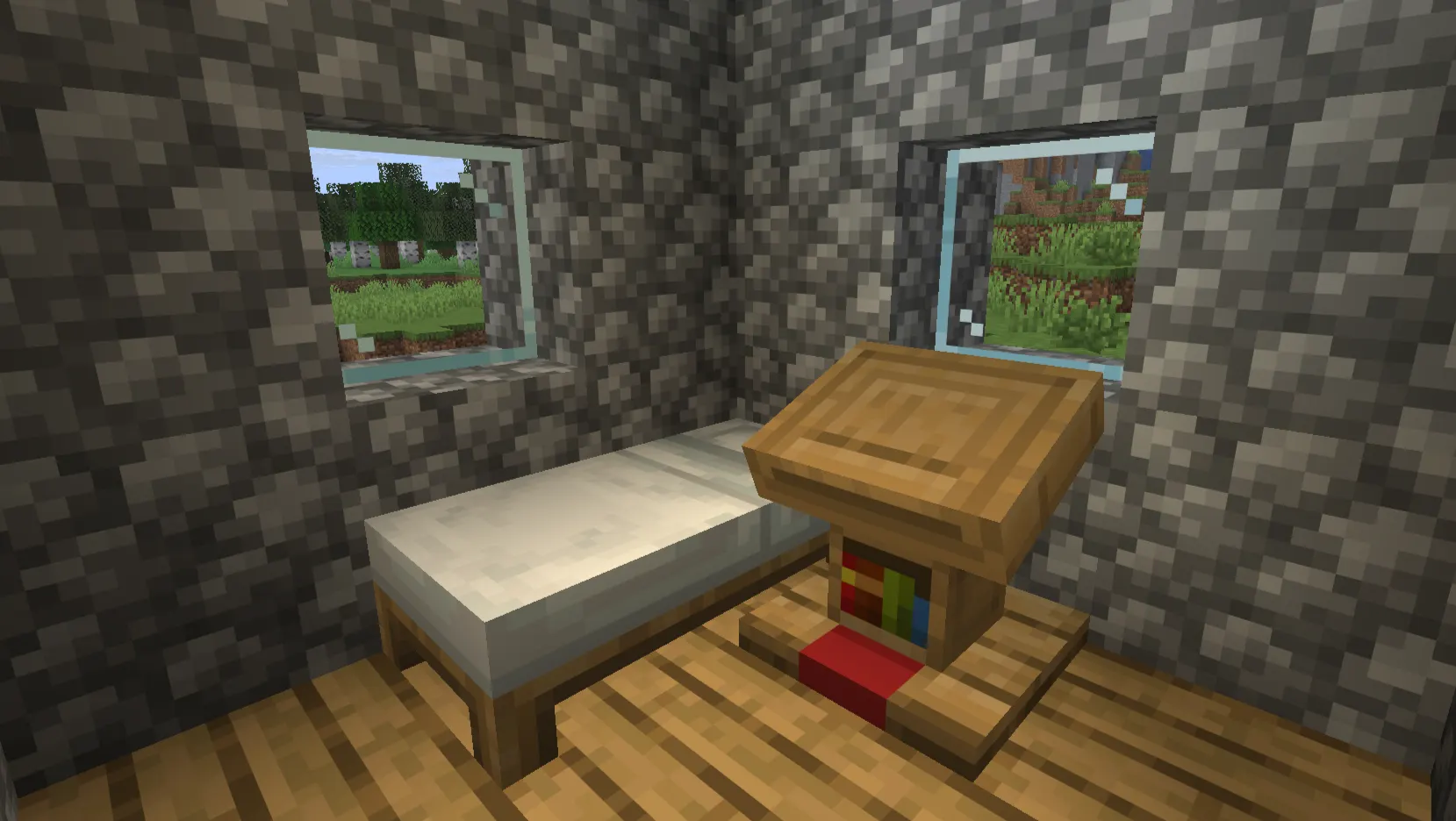
Librarian — Best for Enchanted Books

Workstation: Lectern
If you only build one trading setup this playthrough, make it a librarian. They buy paper and books, and starting at Novice level, they sell enchanted books, bookshelves, glass, lanterns, and at Master tier, name tags.
The enchanted book trade is a random roll each time a trade slot opens, pulled from the pool of enchantments available in the game, including treasure enchantments like Mending and Frost Walker, which normally can't be obtained from an enchanting table at all. That's the real reason librarians dominate every "best villager" conversation: Mending is otherwise locked behind fishing loot tables or rare structure chests, and a librarian can hand it to you directly.
Not every librarian rolls something useful right away. If the Novice trade is junk, break and replace the lectern before trading with that villager to reroll the whole offer table. Once you've traded with it even once, that villager's offers are locked for good, so check before you commit.
A 2026 note on the rebalance: Mojang has an experimental change in testing that would make enchanted book trades tied to the librarian's home biome, with fixed enchantment levels replacing the current random pool. As of mid-2026 this is still opt-in only, enabled through the "Villager Trade Rebalance" data pack on Java or the matching experiment toggle on Bedrock. Unless you've turned that on yourself, your librarians behave the classic way: random enchantment, random level, no biome restrictions. Don't follow advice written around the rebalanced version unless you've actually enabled it.
Fletcher — Best for Easy Emeralds
Workstation: Fletching Table
Fletchers buy sticks, and sticks might be the single cheapest renewable resource in the game. A couple of trees or a bamboo farm keeps a fletcher fed indefinitely, and in exchange you get emeralds along with arrows, bows, and crossbows as the villager levels up.
This is the profession most guides undersell. It's not flashy, but the input cost is close to zero and the setup takes minutes. If your priority on a new world is building up an emerald stockpile fast, without hunting, mining, or farming crops, a fletcher gets there quicker than almost anything else.
Armorer — Best for Armor
Workstation: Blast Furnace
Armorers buy coal and Iron ingots early on, then diamonds once they hit higher tiers, selling iron and chainmail pieces at low levels and enchanted diamond armor at Expert and Master. This is one of the fastest ways to gear up without mining a single diamond yourself, and the enchantments that come attached are randomized just like a librarian's books, so you can end up with genuinely strong pieces.
Set this up once you're stable on iron and have a bit of coal to spare. It pairs naturally with the other two smiths if you want a full equipment shop in one corner of your base.
Toolsmith — Best for Tools
Workstation: Smithing Table
Toolsmiths cover pickaxes, axes, shovels, and hoes, buying coal and iron at low tiers and selling enchanted diamond tools once leveled up. Efficiency and Unbreaking are common rolls here, and buying a pre-enchanted diamond pickaxe saves you the XP cost of doing it yourself at an enchanting table.
This is a background profession more than a headline one. You won't build your whole trading hall around a toolsmith, but having one nearby means you're never stuck replacing a broken pickaxe.
Weaponsmith — Best for Weapons
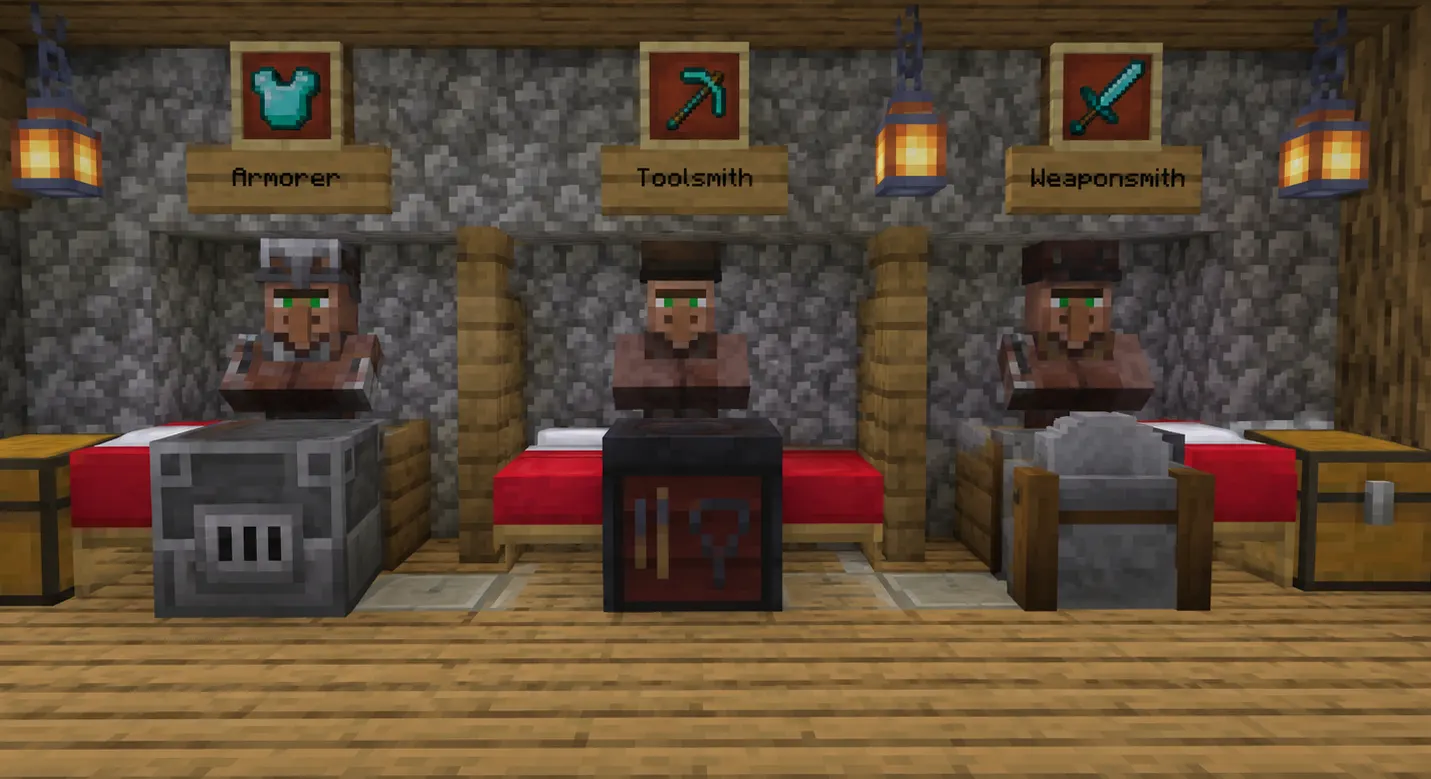
Workstation: Grindstone
Weaponsmiths buy coal and iron ingots, sell iron and diamond swords and axes, and at higher levels start offering enchanted versions. Sharpness, Looting, and Unbreaking all show up in the pool.
Combined with an armorer and toolsmith, this rounds out a full diamond loadout without needing to strip-mine for diamonds at all. If your base already has an iron farm running, feeding all three smiths costs almost nothing.
Cleric — Best for Renewable Resources
Workstation: Brewing Stand
Clerics buy rotten flesh, which every zombie farm produces by the stack, and sell redstone, lapis lazuli, glowstone, and ender pearls, with experience bottles showing up at higher tiers. The ender pearl trade is the standout here. It turns a passive zombie farm into a renewable ender pearl source, which matters a lot if you're not interested in grinding Endermen for hours before an End trip.
This is a profession that gets dramatically better the further into a playthrough you are, since it depends on having a working mob farm to feed it. Early game, it's fine but unremarkable. Once you've got rotten flesh piling up with nowhere to go, a cleric turns that junk into genuinely valuable materials.
Mason (Stone Mason) — Best for Building Materials
Workstation: Stonecutter
Masons buy clay and stone, and sell polished stone variants, bricks, terracotta, quartz, and glazed terracotta. None of it is exciting to look at on a trade list, but if you build a lot, this profession saves real time. Buying a stack of quartz from a mason beats mining a Nether fortress for it, and dyed terracotta in bulk is genuinely hard to get any other way.
Skip this one if you're not a builder. It's purely a quality-of-life pickup for people who care about how their base looks.
Cartographer — Best for Exploration
Workstation: Cartography Table
Cartographers sell maps, banner patterns, and explorer maps that point toward ocean monuments and woodland mansions. That last category is the reason this profession earns a spot on most trading hall lists: buying an explorer map is the most reliable way to find those two structures without wandering the map hoping to stumble onto one.
As of 2026, the cartographer's trade table is one of the two parts of the Villager Trade Rebalance that already shipped as standard, live by default since Java 1.21.5 and Bedrock 1.21.70. That means cartographers now sell biome-specific village maps in addition to the classic monument and mansion maps, and the wandering trader tied to this same rework got better prices and more inventory, along with the ability to buy items from you. If you're playing a current version, this is just how cartographers work now, no toggle required.
Shepherd — Best for Wool and Decorative Items
Workstation: Loom
Shepherds buy wool and dye, and sell dyed wool, beds, banners, and paintings. It's a small-scope profession, but a genuinely convenient one if you keep even a small pen of sheep nearby. You get decoration on demand instead of chasing sheep around with dye in hand.
Fisherman — Best for Fish and Passive Emeralds
Workstation: Barrel
Fishermen buy string and coal, sell campfires and cooked fish, and offer an enchanted fishing rod at Master level. The real value shows up if you already run an AFK fishing setup. All that raw fish you'd otherwise cook and eat can go straight to the fisherman for emeralds instead, turning a farm you built for loot into one that also prints currency on the side.
Butcher — Best for Food Trading
Workstation: Smoker
Butchers buy raw chicken, porkchop, rabbit, and beef, and sell the cooked versions along with rabbit stew and sweet berries. If you're running any kind of animal farm, this profession gives your surplus meat somewhere to go besides a chest you never open again.
Leatherworker — Best for Leather-Related Items
Workstation: Cauldron
Leatherworkers buy leather, rabbit hide, flint, and turtle scutes, and sell dyed leather armor and leather horse armor. Most of the early trades are skippable, since leather armor is easy enough to craft yourself. The one trade worth building a leatherworker for is the Master-tier saddle. Saddles otherwise only come from fishing, loot chests, or trading with this specific profession, so if you'd rather not gamble on either of those, a leatherworker is the dependable option.
Unemployed Villagers and Nitwits
Not every villager in a village is doing a job, and it's worth knowing why.
Unemployed villagers are just villagers without a claimed workstation. They wear plain brown robes and can't be traded with. Give one a nearby job site block and, during the day, it'll walk over and claim it, turning into whatever profession matches that block.
Nitwits are a separate case entirely. They wear a green outfit, can never take a job no matter what workstation you place near them, and can never be traded with. They're not broken or bugged. They're a fixed villager variant that spawns naturally in a village alongside working professions. If you're building a trading hall and want to fill it entirely with productive villagers, Breed extras and move nitwits out, since they take up a villager slot without giving you anything back.
Best Villager Trades for Different Goals
Rather than chasing one "best" villager, match the profession to what you actually need right now.
If you want emeralds: Fletcher first, farmer second. Both run on renewable, low-effort inputs.
If you want enchanted books: Librarian, no contest. It's the only reliable source of Mending outside of loot luck.
If you want diamond equipment: The smith trio (Armorer, Toolsmith, Weaponsmith) covers a full kit without mining.
If you're a beginner: Farmer or Fletcher. Both are cheap to set up and forgiving if you mess up the job-block placement the first time.
If you're building a trading hall: Librarian, Cleric, and the smith trio first. Everything else is a nice-to-have you can add once the core is running.
If you want exploration supplies: Cartographer, for the explorer maps to mansions and monuments.
If you're focused on redstone or brewing: Cleric, for renewable redstone, lapis, and ender pearls.
Best Trading Hall Setup
You don't need a sprawling structure to make villager trading work. A few practical rules matter more than the layout itself.
Start with 4 to 6 villagers, covering whatever professions solve your current problems. You can always expand later, since there's no reason to build out all 13 professions on day one.
Give every villager its own bed, placed close enough that it can path to it at night. A villager without a bed doesn't count as having a home, and that causes restocking and behavior issues down the line.
Keep each villager's job site block within a short, obstruction-free path. Long or blocked routes mean missed restocks.
Transport villagers in minecarts or boats, not by shoving them with your body. It's slower to watch, but far more predictable, and you won't lose a villager off a cliff mid-move.
Cure at least one villager per profession you rely on heavily. The permanent discount adds up fast if you're doing dozens of trades over a playthrough.
Fence or wall the whole setup. Villagers wandering into the open during a raid or a stray zombie spawn is the single most common way a trading hall loses its best members.
Label or separate villagers by profession if your hall gets large. Nothing wastes more time than hunting through a dozen identical-looking villagers for the one selling Mending.
Java vs Bedrock: What's Actually Different
The two editions run on the same basic system, but a few things diverge.
Trade prices and item counts aren't always identical between versions. Bedrock has historically offered slightly different quantities on some trades compared to Java, though the core trade list per profession is the same.
The Villager Trade Rebalance experiment exists on both editions, toggled through the "Villager Trade Rebalance" experimental data pack on Java and the "Villager Trade Rebalancing" experiment setting on Bedrock. As of 2026, the cartographer and wandering trader portions of that rebalance have already graduated into the standard game on both platforms. The librarian and armorer changes are still locked behind the experimental toggle on both editions, so unless you've deliberately opted in, both Java and Bedrock players are seeing the same classic librarian behavior.
If you're following an older guide and something doesn't match what you're seeing in-game, check whether it was written around the experimental rebalance rather than the default trade tables. That mismatch is the most common source of confusion in villager trading content right now.
Villager Trade Rebalance: Where Things Actually Stand
This section exists because so much Minecraft content online treats the rebalance as either already live or as something that got scrapped entirely. Neither is fully accurate.
What's already standard, no toggle needed: the cartographer rework and the wandering trader rework. Cartographers sell biome-specific village maps alongside the classic monument and mansion maps, and wandering traders have better prices, a larger selection, and the ability to buy items from you. This shipped as default behavior starting with Java 1.21.5 and Bedrock 1.21.70.
What's still experimental, opt-in only: the librarian change that would tie enchanted book trades to the villager's home biome and cap them at fixed levels instead of the fully random pool used today. Armorer adjustments are also still part of the experimental side. Neither is active unless you specifically enable the experiment.
Why this matters for you: if you haven't touched your world's experimental settings, your librarians work the way they always have: random enchantment, random level, breakable and rerollable through the lectern trick. Don't plan a librarian-heavy trading hall around biome restrictions that aren't actually affecting your world.
Should you enable it yourself? That's a genuine preference call. The rebalance is meant to slow down how fast players get top-tier enchantments, which some players want for a harder, slower-paced world. Others find the biome-hopping requirement tedious for something that used to take a single lectern and a bit of patience. Try it on a test world before committing your main save.
Common Mistakes
Trading with a villager before checking its offers. Once you trade, even once, the offers lock. Check first, especially on librarians where a reroll is still an option.
Breaking a workstation after trades are locked. This doesn't undo the trade, but it does stop the villager from leveling further until you replace the block.
Mixing up villagers and nitwits. A nitwit will never take a job no matter what block you place. If a villager refuses to claim a workstation, check its outfit before assuming something's broken.
Assuming villagers restock without workstation access. No path to the job block means no restocking, full stop.
Repeating outdated curing advice. Curing the same villager multiple times doesn't stack additional discounts. One cure is enough.
Applying rebalance mechanics to a default world. If you haven't enabled the experimental data pack or toggle, biome-specific librarian trades don't apply to you.
Ignoring Java and Bedrock differences. Trade counts and specifics can vary slightly between editions. Don't assume a guide written for one applies exactly to the other.
Building an oversized trading hall too early. Thirteen professions is a lot of upkeep. Start with what solves your actual problems.
Leaving villagers unprotected. An open trading hall during a raid can wipe out your best villagers in minutes.
The Bottom Line
There's no single villager that beats every other one. A librarian selling Mending solves a different problem than a fletcher printing emeralds or a cleric handing you ender pearls for free. Figure out what you're actually short on right now, whether that's gear, emeralds, exploration tools, or building materials, and set up the profession that fixes it. Everything else can wait until you actually need it.